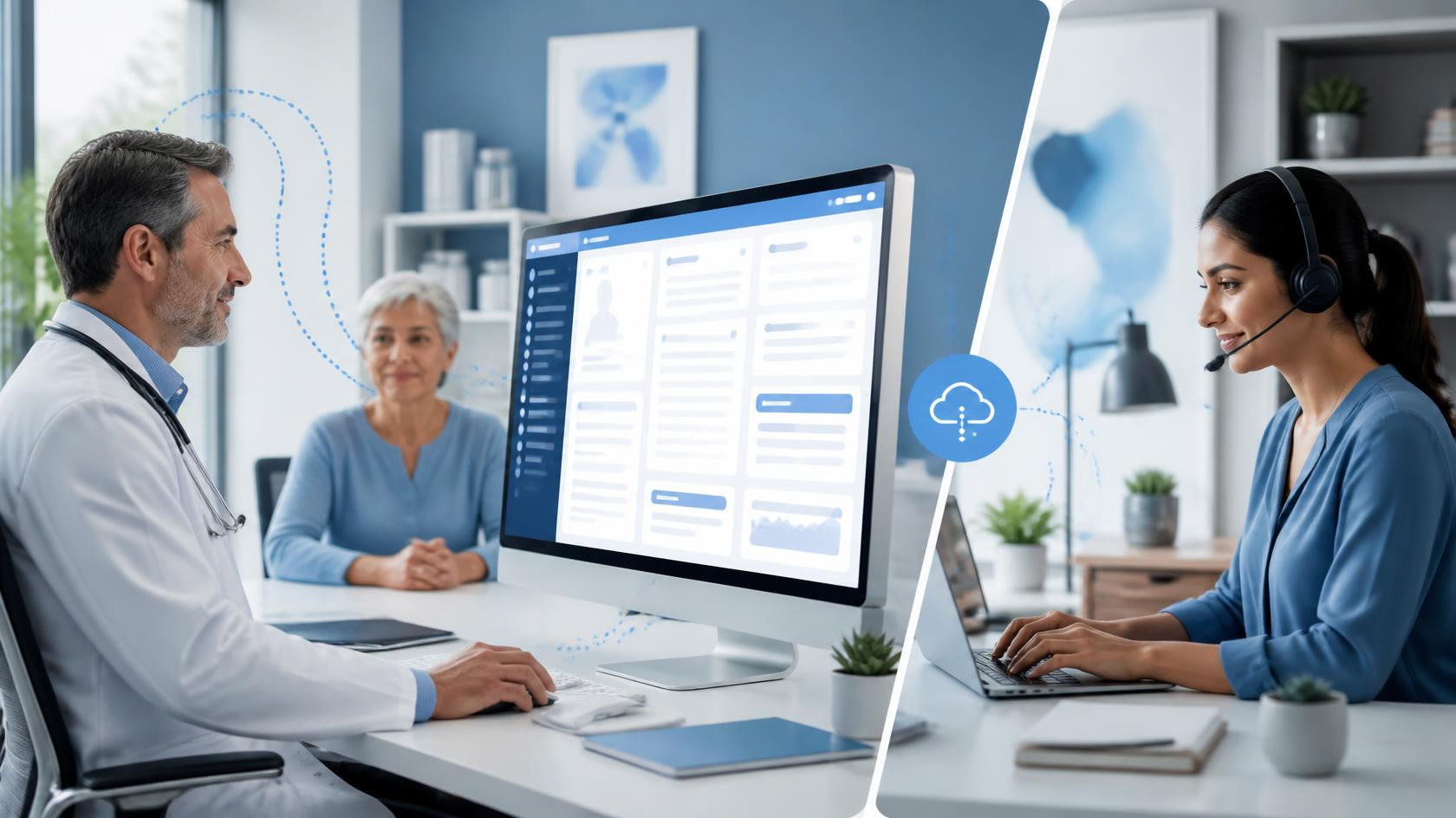
Team Documentation Model: How Virtual Scribes Fit Into AMA's 6-Step Efficiency Framework

Team documentation with a virtual scribe is a structured care-team model in which nonphysician team members including nonclinical documentation assistants such as scribes share the documentation workload during patient encounters, while the physician retains full clinical responsibility. The
virtual scribe captures, organizes, and drafts documentation in real time; the physician reviews, verifies, and signs off.
Team Documentation Is a Care-Team Model, Not Simply a Scribe Service
For decades, clinical documentation defaulted to a single workflow: the physician handled patient care and then documented it often simultaneously or in the hours afterward. The result was a hidden tax on physician time that metastasized into after-hours charting, delayed note completion, and an EHR interaction that competed directly with the patient.
Team documentation is a structural response to that problem. As defined in the AMA STEPS Forward® "Team Documentation: Improve Efficiency of EHR Documentation" toolkit, it is a process in which nonphysician team members assist with documenting visit notes, entering orders and referrals, reconciling medications, and preparing prescriptions during the patient visit. That is a meaningful scope and it is a care-team design decision, not a product purchase.
The AMA framework recognizes two broad categories of documentation support:
Clinical team members — medical assistants, nurses, and other licensed staff who contribute documentation as part of an advanced team-based care model. Their clinical training allows a broader scope within the documentation task.
Nonclinical documentation assistants — transcriptionists, scribes, and similar roles who operate under a clerical documentation assistant (CDA) model. Virtual scribe services fall within this category. The AMA explicitly notes that virtual options for scribes exist.
The distinction matters operationally. A clinical team member handling documentation also brings clinical judgment to the workflow. A nonclinical documentation assistant including a virtual scribe performs documentation support, not clinical decision-making. Practices that conflate the two categories either over-rely on their documentation assistant or under-utilize a clinical team member. The AMA's framework forces that clarity upfront, at the design stage.
A team documentation model distributes documentation responsibilities among physicians and designated clinical or nonclinical team members. A virtual medical scribe can function as a nonclinical documentation assistant, preparing documentation for physician review while the physician retains clinical responsibility and final approval.

Where a Virtual Scribe
Fits Into AMA's Six Steps
The AMA STEPS Forward® toolkit outlines six implementation steps for team documentation. A virtual scribe is not a substitute for working through those steps it is a workflow component that emerges from them. Here is how that relationship maps:
Step 1: Create a Change Team. Before any documentation model can succeed, someone inside the practice must own it. This means identifying a physician champion, a clinical lead, and an administrative stakeholder who will define the workflow, troubleshoot friction, and measure results. A virtual scribe vendor cannot do this work for a practice the internal change team has to exist first.
Step 2: Decide Which Team Members Will Help With Documentation. This is the step where a virtual scribe becomes a genuine design option. The AMA identifies nonclinical documentation assistants including scribes, with virtual options explicitly noted as one category of documentation support. If the practice determines that a nonclinical CDA model fits its clinical environment (typically encounter-heavy, ambulatory settings where the physician leads the patient interaction and needs real-time documentation support), then a virtual scribe is an appropriate fit for evaluation.
Step 3: Choose a Model. The two AMA-defined models advanced team-based care and clerical documentation assistant require different training, scope definitions, and accountability structures. Selecting a virtual scribe means choosing the CDA model. That choice should be documented, communicated to the whole care team, and revisited if practice needs change.
Step 4: Define the Workflow. This step is where the most operational work happens and where documentation quality is determined. The practice must specify: when the scribe connects to the encounter, what the scribe captures versus what is physician-dictated, how note drafts are handed off for review, and how quickly sign-off is expected. A virtual scribe operating without a defined workflow is an expensive transcription service, not a documentation system.
Step 5: Start With a Pilot Team. The AMA recommends piloting the model before practice-wide rollout. For a virtual scribe engagement, this means identifying two or three physicians for an initial period typically 30 to 60 days with consistent encounter volume, willingness to give feedback, and tolerance for the adjustment period that real-time documentation support requires.
Step 6: Assess and Optimize. Measurement is what separates a pilot from a permanent model. Practices should establish baseline metrics before the pilot begins, collect data throughout, and use findings to adjust scope, workflow, or assignment before scaling. (See Section 5 for recommended metrics.)
The takeaway from these six steps is not complicated: a virtual scribe is a workflow component inside the team model, not the model itself. Practices that skip the design work and jump directly to procurement tend to get compliance problems, frustrated physicians, and documentation quality that doesn't hold up to payer scrutiny.
Chase Clinical Documentation supports U.S. medical practices with virtual medical scribe services designed to fit defined team-documentation workflows. A Chase virtual medical scribe can assist with real-time clinical documentation while the physician retains responsibility for clinical decisions, note review, verification, and final sign-off.

What Should Stay
With the Physician
The boundaries between physician responsibility and scribe responsibility are not a legal footnote they are the operational logic that makes the model work. When those lines blur, documentation quality degrades, liability exposure increases, and the model loses physician trust.
The AMA is clear that team documentation redistributes documentation work while the physician retains clinical responsibility. What that means in practice:
Physician responsibilities that do not transfer to a virtual scribe:
- Clinical reasoning and differential diagnosis
- Treatment and care plan decisions
- Interpretation of diagnostic findings
- Direct patient communication and shared decision-making
- Order review and authorization
- Clinical verification of what was documented
- Final note review and attestation
- Addenda when documentation does not accurately reflect the clinical encounter
Documentation support responsibilities appropriate to a virtual scribe:
- Real-time capture of encounter information from audio or live observation
- Organization of patient history, HPI, ROS, and examination findings as directed
- Draft note preparation within the practice's defined templates
- EHR data entry for documentation fields, not clinical orders requiring physician judgment
- Note routing for physician review on the same day as the encounter
- Flagging incomplete or unclear sections for physician clarification
The
risk is not that a physician will accidentally ask a scribe to diagnose a patient. The risk is subtler: over time, physicians who do not review drafts carefully, or who accept documentation that doesn't fully reflect their clinical reasoning, can find themselves with records that don't support their level of service, don't accurately represent their decision-making, or create compliance exposure on audit. The physician's review and attestation is not a formality it is the mechanism through which the CDA model remains clinically and legally sound.

A Practical
Practice Scenario
Consider a six-physician internal medicine group in a mid-sized U.S. market. The physicians see 20 to 24 patients per day, operate on Epic, and complete roughly 30 to 40 percent of their notes after 6 p.m. Unsigned notes at the 48-hour mark are a recurring compliance flag. Two physicians are considering early retirement partly due to documentation burden.
Before team documentation: Each physician documents independently during or after the visit. Rooming is handled by medical assistants, but the MA's documentation role ends at vitals and medication reconciliation. The physician spends approximately 90 minutes per day on after-hours charting.
Workflow redesign: The practice forms a small change team a physician champion, the practice manager, and one medical assistant lead. After reviewing the AMA STEPS Forward® toolkit, they determine the clerical documentation assistant model is the right fit. Their clinical MAs are already stretched; adding documentation to their scope would require a staffing and training investment they are not ready to make. A virtual scribe service fits the CDA model and allows a faster pilot.
Virtual scribe role in the workflow: The scribe connects to encounters via a secure audio link. During each visit, the scribe drafts the note in Epic in real time capturing the HPI, ROS, physical examination findings, and assessment structure using the physician's preferred templates. The draft is available for physician review within 15 minutes of the encounter ending. The physician reviews, makes clinical addenda, and attests.
Physician review remains intact: The physicians set a practice standard: same-day sign-off on all scribed notes before leaving the building. This is not optional it is written into the workflow protocol and tracked by the practice manager.
Early workflow indicators the practice monitors in the pilot: After-hours charting time, note turnaround from visit end to physician attestation, open-note rate at 24 and 48 hours, and physician satisfaction via a structured bi-weekly survey.
This is not a customer case study. It is an illustrative scenario based on the documented operational challenges of high-volume ambulatory internal medicine practices and the parameters the AMA team documentation framework is designed to address.
What Practices Should Measure During the Pilot
The AMA STEPS Forward® toolkit includes a dedicated "Measure the Impact of Team Documentation" resource. Practices that skip measurement are not piloting a model they are adopting one without evidence. A disciplined pilot requires establishing a baseline before the first scribe interaction, not after.
Metrics worth tracking fall into three categories:
Time and completion:
- Physician documentation time per encounter (pre- and post-pilot)
- After-hours charting time (daily average per physician)
- Note turnaround from encounter end to draft availability
- Unsigned/open notes at 24 hours and 48 hours
- Time from draft to physician attestation
Quality and accuracy:
- Documentation correction rate (physician-initiated addenda or overrides per note)
- Consistency of note structure across encounter types
- Workflow interruptions requiring physician re-engagement during documentation
Operational and satisfaction:
- Patient-facing time per encounter (perceived or measured)
- Provider satisfaction tracked by structured survey, not informal feedback
- Scribe-physician assignment stability (continuity affects note quality over time)
One data point that practices underweight: the time physicians spend reviewing and correcting scribed notes. If physician review time is long and correction rates are high, the scribe workflow is saving documentation time but creating review burden. That imbalance is a workflow design problem, not an inherent limitation of the CDA model. It is usually solvable with clearer templates, better encounter protocols, or additional scribe training but only if the practice is measuring it.

Virtual Scribe, AI Scribe,
or Hybrid Documentation Team?
Practices evaluating the CDA model today face a three-way decision that did not exist five years ago:
Human virtual scribe: A trained, remote documentation professional who listens to or observes the encounter in real time and drafts the clinical note for physician review. The scribe adapts to physician preference, specialty nuance, and complex encounter dynamics that require judgment about what belongs in the record. The relationship improves over time as the scribe learns the physician's style. The tradeoff is cost and scheduling coordination.
AI medical scribe (ambient AI): Ambient AI documentation tools capture audio during the encounter and use natural language processing to generate a draft note. They are increasingly capable across common encounter types and offer near-instant draft availability. The tradeoffs are performance variability on complex, atypical, or multi-speaker encounters; the need for consistent physician review workflows; and the compliance and vendor vetting work required before deployment.
Hybrid documentation team: Some practices combine both an AI system that handles routine encounter capture with a human virtual scribe or documentation specialist available for complex cases, documentation review, or quality oversight. This model can optimize cost and coverage but requires a more sophisticated workflow design to manage handoffs between automated and human support.
The AMA STEPS Forward® toolkit was updated to reflect that
AI ambient scribe options exist within the nonclinical documentation assistant category. That inclusion is a recognition that the CDA model is technology-agnostic what matters is whether the documentation support fits the defined workflow, maintains physician accountability at sign-off, and produces records that accurately reflect the clinical encounter. The choice of human, AI, or hybrid should follow from that evaluation, not precede it.
The Framework Is the Starting Point, Not the Finish Line

The AMA STEPS Forward® team documentation framework gives practices a defensible, evidence-informed path to redesigning how clinical documentation gets done. It is not a mandate for any particular documentation solution it is a structured set of decisions that force the right questions before a practice commits to any model.
Virtual scribe support is one legitimate answer to those questions for many ambulatory practices. It fits the clerical documentation assistant model, scales without requiring clinical staff scope changes, and can be piloted with a small physician cohort before full deployment. But it works only when the practice has done the design work first: defined the workflow, set the physician review standard, established baseline metrics, and identified someone internally accThe Framework Is the Starting Point, Not the Finish Lineountable for optimization.
Practices that approach documentation redesign as a purchasing decision get purchasing-decision results. Practices that approach it as an operational design challenge with the AMA framework as the starting structure are far better positioned to get the outcome that actually matters: physicians spending more time on patient care and less time on the EHR.
Chase Clinical Documentation provides virtual medical scribe and AI scribe services to U.S. physician practices across a range of specialties and EHR platforms. To learn how virtual scribe support fits into your documentation workflow,
contact Chase Clinical Documentation or explore our
virtual medical scribe services.
Chase Clinical Documentation provides virtual medical scribe and AI medical scribe services for U.S. healthcare practices. Our documentation models are designed to fit established physician workflows, EHR processes, specialty requirements, and physician review protocols. Whether a practice uses a human virtual scribe, AI medical scribe, or hybrid model, the goal is the same: reduce documentation burden while keeping clinical judgment and final documentation responsibility with the physician.
The AMA STEPS Forward® program content referenced in this article is provided for informational purposes only. The AMA does not endorse any specific commercial documentation service. For the full Team Documentation toolkit,
visit AMA STEPS Forward®.
FAQ
What are the six steps in the AMA team documentation framework?
The AMA Team Documentation framework uses six steps: create a change team, decide which team members will support documentation, choose a documentation model, define the workflow, start with a pilot team, and assess and optimize the process. The framework helps practices design documentation around their specific staffing, workflow, and operational needs.
Does every physician in a practice need to use the same team documentation workflow?
No. A team documentation model can be standardized at the practice level while allowing physician-specific preferences within defined boundaries. Templates, note styles, encounter types, and review routines may differ by provider, provided responsibilities, quality standards, EHR processes, and final physician review remain clearly defined.
How long should a team documentation pilot run before a practice expands it?
There is no universal pilot length for every practice. A useful pilot should run long enough to establish a baseline, observe recurring encounter patterns, collect physician feedback, and compare workflow metrics before and after implementation. Practices can then use the evidence to decide whether to refine, expand, or change the model.
What should a practice change when a virtual scribe saves typing time but increases note review time?
The practice should examine the workflow rather than assuming the scribe model has failed. High review time can result from unclear templates, incomplete workflow rules, inconsistent documentation preferences, or insufficient scribe training. Tracking correction rates and physician review time can show where the process needs refinement before broader deployment.
Can a team documentation model use both clinical staff and a virtual scribe?
Yes. Team documentation does not necessarily mean choosing only one type of support. A practice can define different documentation responsibilities for clinical team members and nonclinical documentation assistants based on role, training, workflow, and scope. The important requirement is that each responsibility is clearly assigned and the physician retains clinical accountability.
When is a team documentation model ready to scale across a medical practice?
A model is more ready for expansion when the pilot shows consistent documentation quality, manageable physician review time, reliable workflow handoffs, improved chart completion, and positive provider feedback. Practices should also document the process clearly enough that additional physicians can adopt it without creating inconsistent standards or new administrative bottlenecks.
Recent Posts