Multi-Speaker Clinical Encounters:
How Virtual Scribes Document Family Members, Interpreters, and Caregivers Without Losing Accuracy

The visit is a medication management follow-up for an 82-year-old patient with heart failure and mild cognitive decline. His daughter is present and doing most of the talking. A professional Spanish interpreter is also in the room relaying the physician's questions and the patient's occasional responses. At one point, all three speak within thirty seconds of each other. The patient says he feels better. His daughter says he fell twice last week and stopped taking the diuretic. The interpreter is still translating the previous question.
A
virtual medical scribe is monitoring that encounter remotely. The challenge isn't capturing words it's producing a clinical note that accurately reflects who said what, which information came from the patient directly, what was secondhand caregiver observation, and how interpreter-mediated communication should be represented. Those distinctions aren't cosmetic. They affect how the physician interprets the record and what decisions follow from it.
The Four-Voice Problem
Most clinical documentation training focuses on the two-person encounter: physician asks, patient responds. Real visits are often more complicated. When a family member or caregiver attends, when a professional medical interpreter is involved, or when both are present simultaneously, a scribe is managing four distinct sources of information each with different clinical weight.
Family Member
These voices don't have equal clinical authority, and the documentation shouldn't treat them as if they do. What the patient reports directly, what a caregiver observed at home, and what was relayed through an interpreter all need to be traceable in the final note not blended into a single undifferentiated paragraph.

What the Note Must Preserve:
Source, Context, and Relevance
A useful framework for organizing multi-speaker documentation involves four questions for each piece of clinical information captured during the encounter:
- Source — Who provided this information? The patient, the caregiver, the physician, or the interpreter?
- Context — Was it a direct statement, a secondhand observation, or an interpreter-mediated exchange?
- Clinical meaning — Is this information relevant to the current encounter, the assessment, or the plan?
- Verification — What does the physician need to confirm or clarify before the note is finalized?
Applying this consistently is what separates an accurate multi-speaker clinical note from one that records a conversation without making sense of it. A good multi-speaker clinical note is not a transcript of every voice in the room. It is an organized, accurate record that preserves the source, context, and clinical relevance of information discussed during the encounter with the physician's review as the final step.
Three Situations Where
Speaker Attribution Matters
Scenario 1: Elderly Patient and Adult Daughter
A 78-year-old patient presents for a follow-up. He provides limited history, saying he has been "fine." His daughter, who accompanies him, reports that he has been confused in the evenings, missed two doses of his blood pressure medication last week, and had a fall in the bathroom on Saturday. She also mentions that his cardiologist recently adjusted his beta-blocker dosage.

The documentation risk here is straightforward: the daughter's observations must not be written as if they came from the patient. "Patient reports confusion" is a materially different clinical statement than "daughter reports observed confusion in the evenings." The first implies the patient has insight into the symptom. The second is collateral history clinically useful, but clearly secondhand.
A well-organized note in this scenario separates patient-reported information from caregiver-reported history without implying that one overrides the other. The physician reads both and decides what to do with each the scribe's job is accurate attribution, not clinical interpretation.
Scenario 2: Patient and Professional Medical Interpreter
A patient whose primary language is Somali is seen in an internal medicine clinic. The physician asks about chest pain onset. The interpreter relays the question. The patient responds at length. The interpreter provides a summary in English. A second exchange clarifies whether the pain radiates.
The scribe's role in an interpreter-assisted visit is to capture the clinical content of the communication, not to document the mechanics of interpretation. The note should reflect what the patient communicated about the chest pain onset, character, radiation, associated symptoms not a narration of which language was spoken or how many exchanges occurred.
Practically, that means writing: "Patient reports substernal chest discomfort for three days, radiating to the left arm, with no associated shortness of breath, via interpreter." The attribution "via interpreter" identifies the communication pathway without requiring a transcript of the interpreted exchange.
One important distinction:
a virtual medical scribe supports documentation. A qualified medical interpreter handles clinical communication. These are separate roles and neither substitutes for the other.
Scenario 3: Four Voices, One Encounter
A geriatric patient with poorly controlled type 2 diabetes and early dementia is seen for a complex medication management visit. His wife and his adult son are both present. A Mandarin interpreter is also attending. During the visit, the physician discusses the patient's HbA1c, the son raises a concern about hypoglycemic episodes at home, the wife mentions a new supplement the patient has been taking, and the patient responds in Mandarin to the interpreter's relay of the physician's medication question.
In a four-person encounter, the scribe's priorities are clear even when the conversation isn't:
- Correct attribution first. Each piece of clinical information is tied to its source before anything else.
- Clinical relevance second. Not every statement made in the room belongs in the medical record. The supplement is relevant; the son's brief off-topic comment about parking is not.
- Chronology and context third. The order in which information was discussed can matter a physician's question about hypoglycemia that followed the son's concern should be reflected as such.
- Physician assessment fourth. The physician's interpretation and documented decision-making sit above all incoming information.
- Verification last.
The physician reviews the draft before it enters the EHR this step closes the loop on any attribution uncertainty.
When Several
People Speak at Once
Multi-speaker encounters create specific documentation risks beyond simple attribution. The following situations come up regularly in real practice:
Overlapping speech. When a caregiver interjects while the patient is responding, or the interpreter begins translating before the patient finishes, there's a risk of capturing an incomplete patient response. A scribe working in real time must recognize when a statement was interrupted and capture only what was actually communicated not infer a complete thought from a partial one.
Pronoun ambiguity. Statements like "she said he stopped taking it" or "her son noticed the swelling" require the scribe to maintain a mental model of who is in the room and which person each pronoun refers to. In fast-moving conversations, pronoun errors can attribute a caregiver's symptom report to the patient or misidentify who experienced an adverse event. Context maintained throughout the encounter is the only reliable fix.
Multiple people discussing the same medication. When the patient, a family member, and the physician all reference a medication possibly using different names, doses, or timeframes the note needs to clarify which piece of information came from which source. The patient saying "I take the small white one" and the caregiver providing the actual drug name are two different contributions that shouldn't be collapsed into a single medication entry without physician review.
Side conversations that aren't chart-worthy. Not everything spoken during a clinical encounter belongs in the medical record. Family members may discuss logistics among themselves. An interpreter may ask a clarifying question mid-relay. A scribe's judgment about what constitutes clinically relevant documentation versus ambient conversation is part of the core competency, not an afterthought.
The Scribe's
"Do Not Assume" Rules
Multi-speaker encounters are where documentation assumptions do the most damage. Practical discipline around what not to do is as important as knowing what to capture:
- Do not assume the caregiver's report is the same as the patient's report. Attribute each separately.
- Do not attribute secondhand history directly to the patient. "Patient's daughter reports" is different from "patient reports."
- Do not treat every spoken sentence as chart-worthy. Side conversations, logistics, and ambient exchanges are not clinical documentation.
- Do not convert an interpreted exchange into a direct patient quote unless the clinical context clearly supports it.
- Do not resolve ambiguity by guessing. Flag it in the draft for physician review instead.
- Do not finalize the note without physician review and approval, regardless of documentation complexity.
Secure Audio Is a Workflow Issue, Not Just a Technology Feature
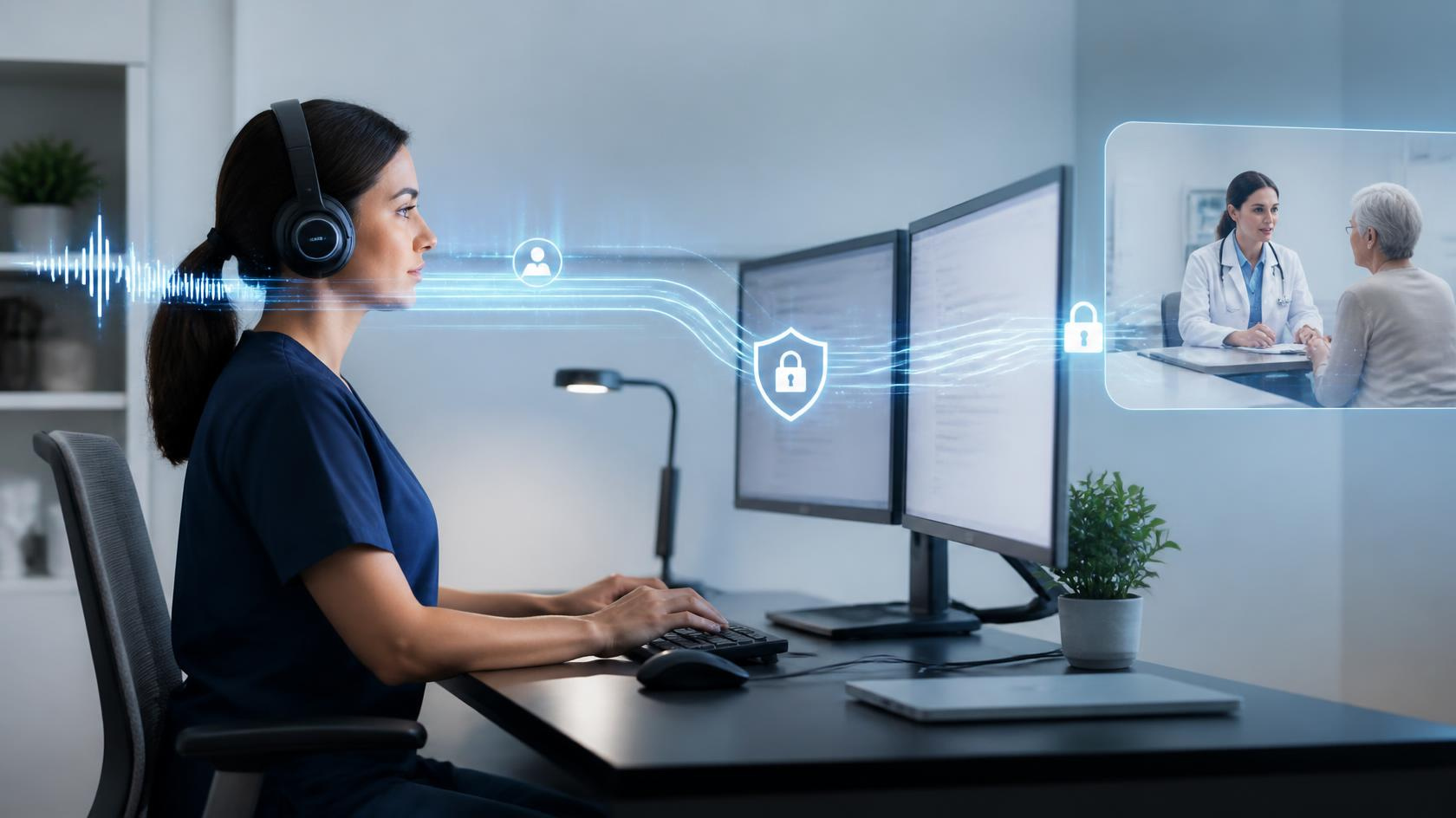
When clinical encounters involve remote documentation support, audio or video of the visit may be transmitted to and monitored by a scribe working offsite. Organizations should ensure that any such workflow incorporates appropriate administrative, physical, and technical safeguards for protected health information, consistent with HIPAA requirements and applicable organizational policies.
This includes controlling who has access to encounter audio or transcripts, how data is transmitted and stored, and how access is terminated after documentation is complete. The HHS Office for Civil Rights provides guidance on HIPAA Security Rule requirements that apply to electronic protected health information, including transmission safeguards.
Audio capture for documentation purposes is a separate matter from patient consent to record, which can vary by jurisdiction, organizational policy, and clinical circumstance. Practices implementing virtual medical scribe services should verify applicable requirements with their compliance and legal teams rather than relying on general assumptions about what is permitted.
The relevant questions aren't only about whether a workflow uses encrypted channels they also include who has access to encounter data, under what conditions, and for how long. These are organizational decisions, not defaults set by technology.
What the Physician
Should Verify Before Signing
Physician review carries particular importance in multi-speaker encounters because attribution errors don't always surface as obvious factual mistakes they can appear as plausible but inaccurate clinical statements. Before finalizing a note from a complex, multi-voice visit, it helps to work through a short verification checklist:
- Is each piece of history attributed to the correct source — patient, caregiver, or interpreter-mediated communication ?
- Are caregiver-reported observations clearly identified as such and not written as direct patient history?
- Does the medication information in the note reflect a single consistent source, or does it need clarification?
- Are interpreter-assisted exchanges documented by their clinical content rather than as a transcript of the relay?
- Is there any ambiguous pronoun reference or unclear attribution that should be corrected before the note enters the EHR?
- Does the assessment and plan reflect the physician's clinical reasoning, not a summary of what the loudest voice in the room said?
The physician's review and approval is always the final step. For
EHR documentation workflows that involve multi-speaker encounters, this review is where attribution errors are caught before they become part of the permanent record.

Documentation
Judgment Is the Core Skill
Whether a practice uses a human virtual medical scribe monitoring an encounter in real time or an AI medical scribe with automated transcription and summarization, multi-speaker encounters test the same underlying capability: the ability to organize information by source, preserve relevant context, and produce a note that accurately reflects what happened without turning the clinical record into a conversation log.
Technology can assist with speaker recognition and transcription speed. It doesn't substitute for the judgment required to decide that a caregiver's statement about a missed dose is clinically significant, that the patient's brief interjection about a new supplement warrants inclusion, or that a side conversation about transportation logistics does not belong in the note at all.
For practices handling a significant volume of complex encounters geriatric evaluations, chronic disease follow-ups with caregiver involvement, specialist consultations using professional interpreters documentation quality in multi-speaker visits is worth evaluating explicitly, not assuming it will work itself out.
Chase Clinical Documentation provides virtual medical scribe services for practices across a range of specialties and encounter types, including visits that involve caregivers, professional interpreters, and multiple speakers. For practices exploring AI-assisted documentation, EzyScribe offers an AI medical scribe solution built with physician review at the center of the workflow.
FAQ
What is a multi-speaker clinical encounter?
A multi-speaker clinical encounter is any visit where more than the physician and patient contribute information during the same appointment. This includes encounters with an adult family member or caregiver present, a professional medical interpreter facilitating communication, or both. These visits create distinct documentation challenges because each participant may provide different types of clinical information that must be attributed correctly in the final note.
How does a virtual medical scribe document caregiver information?
A virtual medical scribe documents caregiver information by attributing it clearly to the caregiver not the patient. Observations a family member or caregiver reports about the patient's condition, behavior, or medications are recorded as caregiver-reported history or collateral history, separate from what the patient stated directly. This distinction matters for clinical accuracy and helps the physician interpret the source and reliability of each piece of information in the record.
Can a virtual medical scribe support interpreter-assisted visits?
Yes. A virtual medical scribe can document interpreter-assisted visits by capturing the clinical content of the communication rather than transcribing the interpreted exchange itself. The note reflects what the patient communicated symptoms, history, responses with a notation that the information was relayed via interpreter. The scribe does not replace a qualified medical interpreter; the two roles remain distinct throughout the encounter.
How does a scribe prevent speaker attribution errors?
Speaker attribution errors are prevented through consistent documentation discipline: identifying who is speaking before recording what was said, avoiding pronoun assumptions in fast-moving conversations, separating caregiver observations from patient-reported history, and flagging any ambiguity in the draft for physician review rather than guessing. No attribution should default to the patient when the actual source is a caregiver, a family member, or an interpreter relay.
What should physicians verify before signing a multi-speaker clinical note?
Before signing, physicians should verify that each piece of history is attributed to the correct source, that caregiver-reported observations are clearly distinguished from direct patient statements, that medication information reflects a consistent and identifiable source, that interpreter-assisted exchanges are documented by their clinical content rather than as a relay transcript, and that no pronoun ambiguity or unclear attribution remains in the note. The physician's review closes the accuracy loop on every multi-speaker visit.
Recent Posts