How Does an AI Medical Scribe Work? From Spoken Conversation to Clinical Note

An AI medical scribe converts a patient encounter into a clinical note by combining automatic speech recognition (ASR) with clinical language processing and note-generation models. It transcribes the conversation, separates clinically relevant details from small talk, places them into note sections such as a SOAP structure, and produces a draft the physician reviews before it enters the EHR.
So
how does an AI medical scribe work between the exam room and the medical record? Most explanations stop at "it listens and writes." The more useful question is what happens to the information in between. Workflows, capabilities, and review models vary by platform, but the underlying transformation is similar.
From Conversation to Clinical Note: What Changes at Each Stage
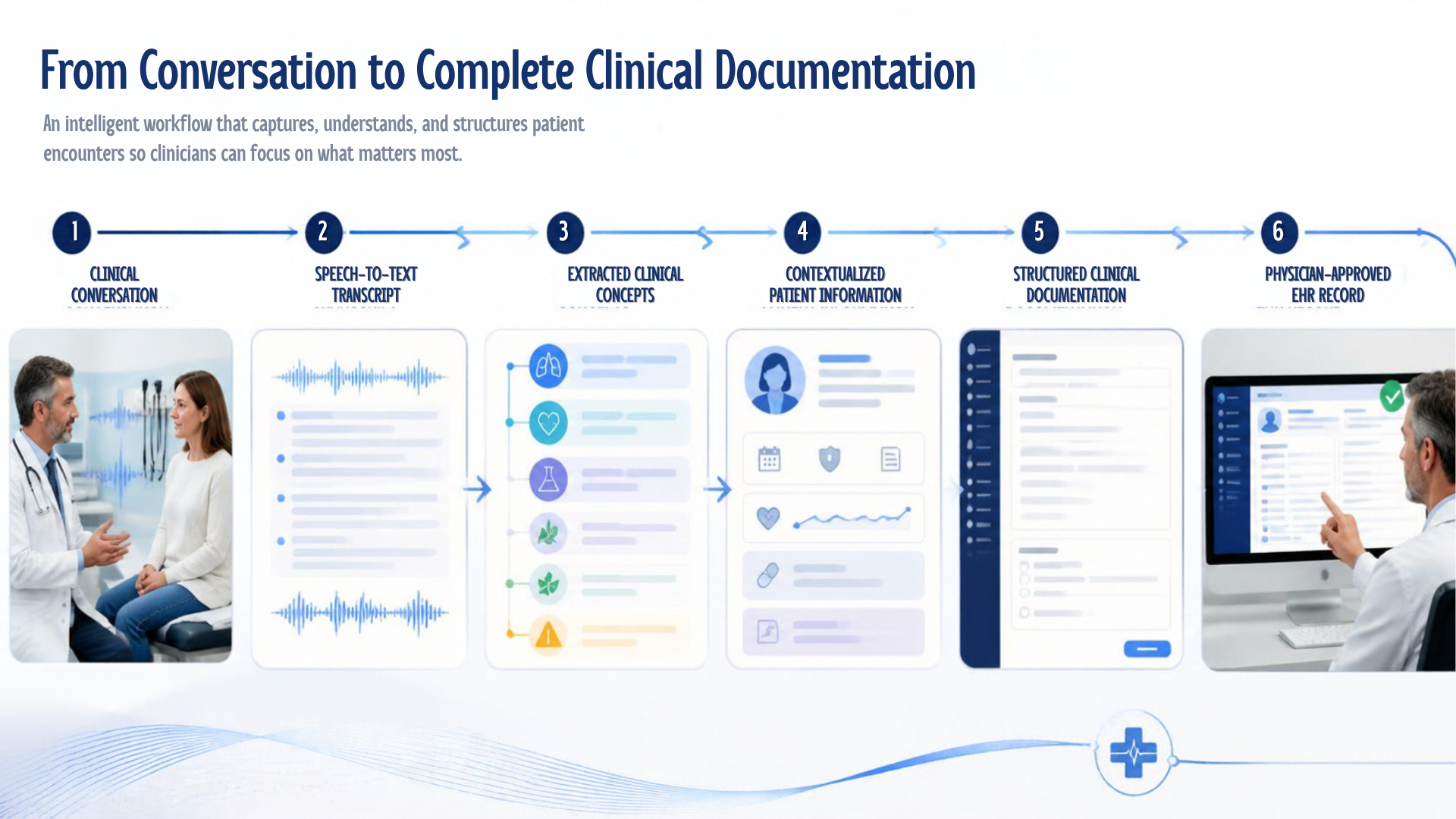
How AI scribing works is easiest to see as a pipeline. Each stage hands the next a more structured version of the same information.
| Stage | Input | AI processing | Documentation output |
|---|---|---|---|
| Capture and ASR | Audio of the patient encounter | Converts speech to text, often labeling speakers | Raw transcript |
| Language processing | Transcript | Recognizes symptoms, medications, doses, durations, negations | Tagged clinical concepts |
| Extraction and context | Tagged concepts | Links each fact to who said it, when, and why | Attributed clinical facts |
| Section assignment | Attributed facts | Maps facts to HPI, ROS, exam, assessment and plan | Organized note content |
| Draft generation | Organized content | Writes clinical prose in the chosen format | Draft clinical note |
| Review and sign-off | Draft note | Clinician edits and approves | Final medical record entry |
Why Speech
Recognition Alone Is Not Enough
ASR produces words, not documentation. A raw transcript is chronological, full of interruptions, and indifferent to relevance. A clinical note is organized by meaning.
That gap is why
how NLP supports AI medical scribing matters. The system must recognize that "no chest pain" is a denial, not a symptom. It must recognize that "my mother had a stroke" belongs in family history, not the patient's problem list. And it must anchor "it started Tuesday" to a date. Without this contextual interpretation, an accurate transcript can still become an inaccurate note.
How the System Decides Where Information Belongs
Section assignment is pattern recognition guided by the note format. In an AI-generated SOAP note, onset, severity, and timing of a complaint typically land in the HPI. Symptoms reported by body system go to the review of systems. Findings the clinician states aloud feed the objective section, and where a platform integrates with the EHR, vitals or results may be drawn from the chart. The assessment and plan reflect what the physician actually says: impressions, orders, and follow-up.
The scribe does not reach its own clinical conclusions. It organizes what was said. Other formats, such as DAP or specialty templates, change the destination sections, not the principle.
A Fictional Example
Invented for illustration; no real patient information.
Patient:
"The cough's been going about five days. I had a fever Tuesday night, but it's gone. No chest pain."
Patient:
"I stopped my lisinopril last week. My sister thinks that's causing the cough."
Physician: "Lungs sound clear. Let's get a chest X-ray, and I'll switch you to losartan."
Draft note elements:
HPI: Five-day cough. Fever Tuesday night, resolved. Denies chest pain.
Medications: Patient self-discontinued lisinopril last week.
Exam: Lungs clear.
Plan: Chest X-ray planned. Change lisinopril to losartan.
Notice what is missing. The sister's suspicion never becomes a diagnosis, because the physician did not state one. Also notice "let's get" is ambiguous: is the X-ray ordered or merely discussed? A reviewer has to settle that.
What the AI Cannot
Safely Determine
An AI-generated note is a documentation draft, not a clinical decision. It cannot judge whether the cough is medication-related, whether an unspoken exam finding was normal, or what a physician meant by "the usual dose." Transcription errors, omissions, and sound-alike drug names can carry forward into the note. Attribution also gets harder when family members, interpreters, or caregivers join the visit; Chase covers this in its post on multi-speaker encounters.
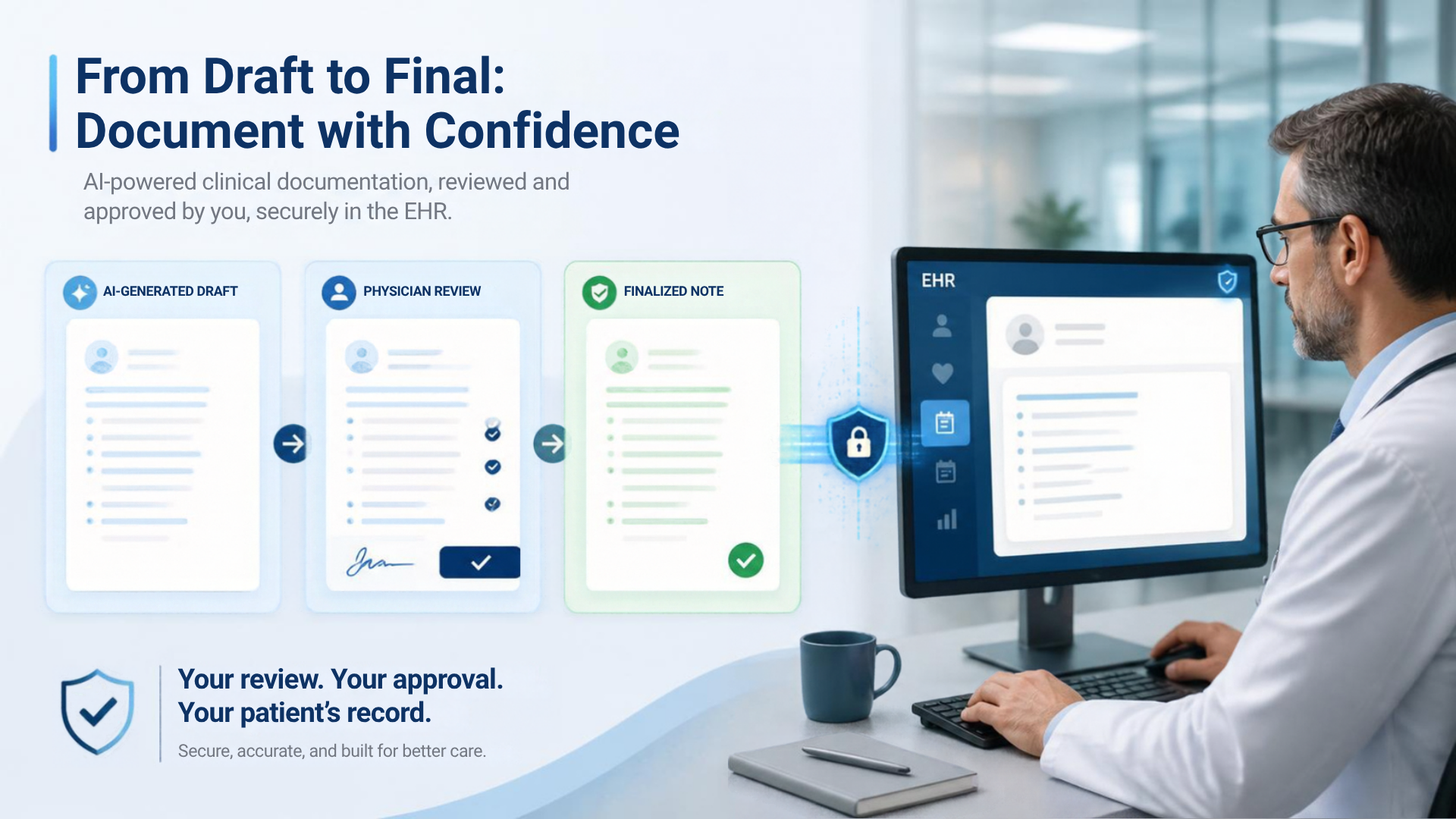
That is why physician review matters: the clinician remains responsible for the record's content. Studies of ambient AI scribes, including a 2024 NEJM Catalyst evaluation of one health system's rollout, focus largely on documentation burden. They do not remove the need to check each note.
Privacy is a separate question. Under
HHS guidance, whether a vendor is a business associate depends on whether it creates, receives, maintains, or transmits PHI on behalf of a covered entity. Practices should confirm the arrangement, and any BAA, with each vendor.
Review, Sign-Off,
and the EHR
After generation, the note goes through quality review. In some workflows that is the physician alone. In hybrid models, a trained human editor checks the draft first. Ezyscribe AI clinical documentation, used within Chase Clinical Documentation's AI Medical Scribe service, pairs ambient capture and structured notes with human review, so the physician verifies an EHR-ready draft rather than a raw transcript.
The physician then edits, approves, and signs. Only then does the note become part of the medical record. How it reaches the EHR, through direct integration or another method, varies by platform and EHR. For a framework on checking drafts, see
reviewing AI-generated clinical notes.
Conclusion
So how does an
AI medical scribe work? It turns speech into text, text into clinical concepts, concepts into organized note sections, and sections into a draft a physician verifies. Each stage narrows the distance between conversation and documentation, while clinical judgment and accountability stay with the clinician.
FAQ
What happens after an AI scribe transcribes a conversation?
The transcript is processed to identify clinical concepts such as symptoms, medications, and durations. The system then links them to context, such as who reported them and when. It assigns them to note sections and drafts the note for review. Transcription is only the first stage.
Does a physician have to review an AI-generated clinical note?
Yes. An AI-generated note is a documentation draft. The treating clinician is responsible for the record, so the note should be reviewed, corrected, and approved before it is finalized. Some services add human editing first, but clinician sign-off still applies.
Can AI medical scribes understand clinical context?
Partly. Language models can recognize negation, timing, medication names, and who said what. They can still misread ambiguous phrasing, overlapping speakers, or unstated findings. That is why review matters, especially for complex or multi-speaker visits.
Do AI scribes use information from the patient's chart?
Some do, if the platform integrates with the EHR and the practice enables it. Capabilities vary widely. Others work only from the encounter conversation, so ask each vendor what chart data it can read and how it is used.
Is a BAA always required for an AI medical scribe?
Not automatically in every case. HHS explains that business associate status depends on the functions a vendor performs and whether it creates, receives, maintains, or transmits PHI for a covered entity. Practices should evaluate each arrangement and confirm requirements with compliance counsel.
Can an AI scribe write notes other than SOAP?
Often, yes. Many platforms support other formats, such as progress notes, H&Ps, or specialty templates. Available formats and customization differ by vendor, so confirm them during evaluation.
Recent Posts