AI Medical Scribe vs AI Scribe vs
Ambient AI: What Is the Difference?

If you have searched for AI documentation software recently, you have almost certainly encountered several terms used interchangeably sometimes by the same vendor in the same brochure. "AI scribe." "AI medical scribe." "Ambient AI." "Ambient medical scribe." Each phrase appears credible, yet none of them carries a single, industry-standardized definition. That inconsistency creates a genuine problem for physicians and practice administrators trying to evaluate documentation technology: the label on a product tells you very little about what that product actually does.
This article maps the terminology so you can ask better questions before evaluating any solution.
The Short Answer: These Terms Describe Different Layers
AI scribe is the broadest everyday term it refers to any software that uses artificial intelligence to assist with documentation. AI medical scribe specifies that the documentation function is healthcare-oriented: clinical notes, encounter records, EHR integration. Ambient AI describes a method of capture passive, background listening during a natural conversation not a complete documentation product. Ambient medical scribe combines that passive capture approach with healthcare-specific note generation. Medical documentation AI is a broader category encompassing all AI applied to clinical record-keeping.
Think of the Terms as a
Technology Stack, Not Separate Products
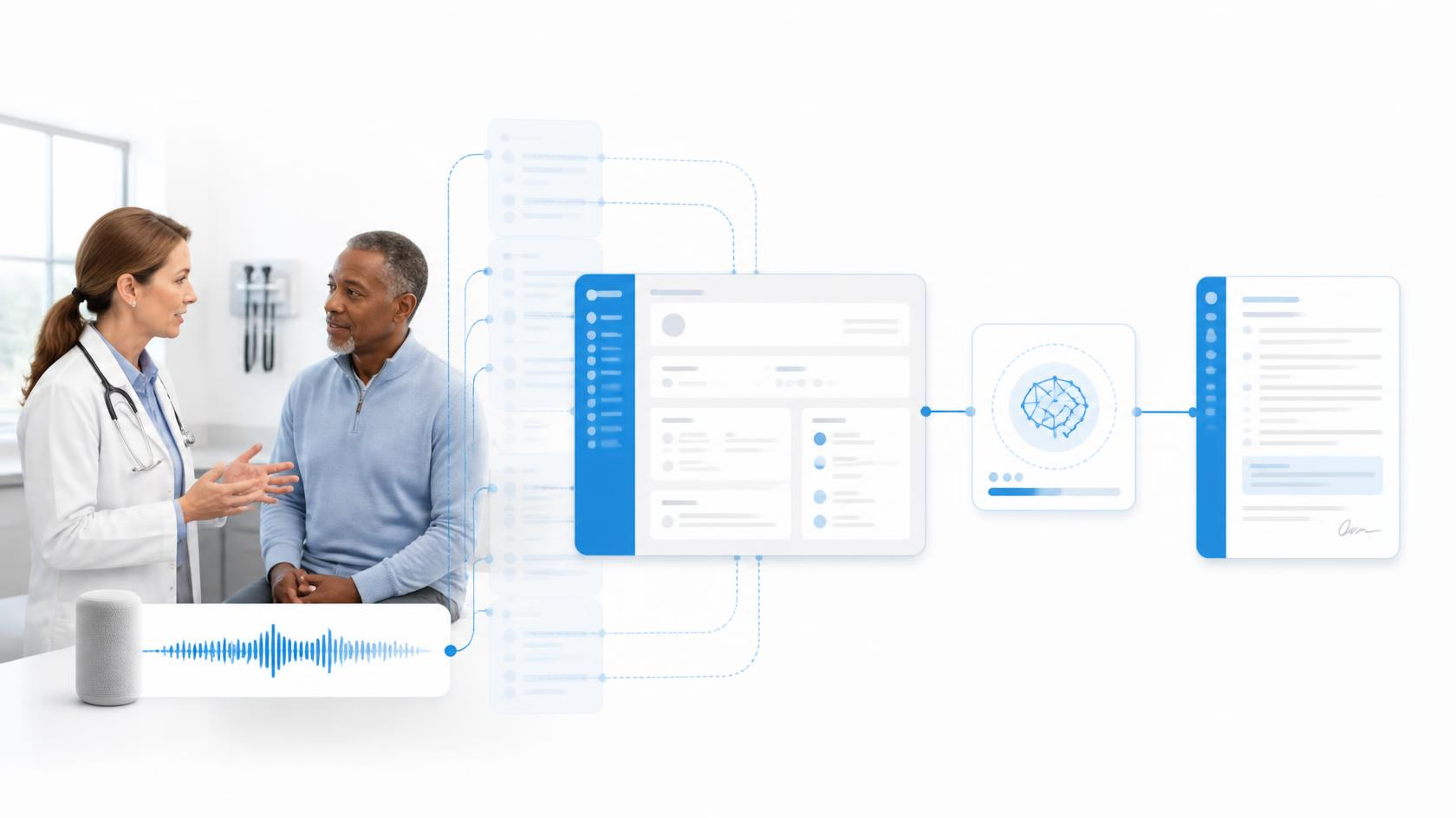
The confusion surrounding these terms largely disappears when you understand that they refer to different layers of the same technology not to six distinct tools.
Patient-provider conversation → Ambient or voice capture (how audio enters the system) → Speech recognition (audio converted to text) → Clinical language processing (medical terms identified and contextualized) → AI documentation engine (draft note assembled) → Structured clinical note → Physician review → EHR or documentation workflow
"Ambient AI" lives near the top of that stack it describes how audio is captured. "AI medical scribe" describes the documentation engine and its output. A single vendor product might involve both layers, but the terms are not synonyms: one describes input method, the other describes output function.
Understanding this distinction matters when a vendor describes their product as "ambient AI" but you actually need to evaluate note quality, specialty support, and EHR integration. Those are downstream questions about the documentation layer, not the capture layer.
AI Scribe Is the
Broadest Everyday Term
"AI scribe" functions in healthcare the way "streaming service" functions in entertainment it tells you the general category without specifying what you are actually getting. A product marketed as an AI scribe might generate clinical notes automatically, assist with real-time transcription, support post-visit dictation editing, or some combination of all three. Implementations vary considerably between vendors.
This matters practically because two products both called "AI scribes" may have entirely different underlying processes, accuracy profiles, specialty coverage, and physician-review requirements. The label alone is not a reliable basis for comparison. When evaluating any AI scribe, the appropriate question is: what, specifically, does this system capture, generate, and require the clinician to review?
AI Medical Scribe
Adds the Clinical Context
"AI medical scribe" is more specific than "AI scribe" in one important respect: it signals that the output is designed for clinical documentation within healthcare settings encounter notes, SOAP formats, specialty-specific documentation structures, and integration with EHR platforms.
That specificity matters because clinical documentation carries obligations that general transcription does not. Notes become part of a patient's permanent medical record. They inform coding and billing. They carry medicolegal weight. A system built for healthcare documentation should handle medical terminology, speaker attribution, contextual clinical information, and physician review workflows in ways that generic AI transcription tools are not designed to address.
For a deeper look at what constitutes a fully realized AI medical scribe and what to verify before adoption, the
Chase Clinical Documentation AI Medical Scribe guide covers those criteria in detail.

Ambient AI Describes
HOW the System Listens
This distinction is the most commonly misunderstood and the most commercially significant.
"Ambient AI" is primarily a description of the capture modality, not the complete documentation solution. An ambient AI system listens passively in the background while a physician and patient speak naturally. There is no pause-and-dictate requirement, no formal command structure, and no interruption of the clinical conversation. The system collects audio contextually as the encounter unfolds.
What happens after that capture varies substantially between products. Some ambient AI systems generate a near-complete clinical note. Others produce a rough transcript that requires significant editing. A few function primarily as audio capture platforms that integrate with separate note-generation tools. Describing a product as "ambient AI" tells you how it listens it does not automatically tell you what it produces.
For physicians and administrators evaluating ambient documentation solutions, the relevant follow-up questions are: What does the ambient capture produce? How is clinical terminology processed? How complete is the generated note? What does the physician review before signing? The role of natural language processing in that pipeline is explored further in the Chase
guide to NLP and AI medical scribes.
Where the Three Terms Overlap
| Term | Primarily describes | Typical healthcare use | What to verify |
|---|---|---|---|
| AI scribe | AI-assisted documentation, broadly | Any setting using AI to reduce manual documentation | Which specific documentation functions are included |
| AI medical scribe | Healthcare-specific documentation output | Clinical notes, EHR integration, physician review workflow | Note formats, specialty support, EHR compatibility |
| Ambient AI | Passive, background capture method | Natural patient-provider conversations without dictation prompts | What the captured audio produces downstream |
| Ambient medical scribe | Ambient capture + clinical note generation | Full encounter documentation from natural conversation | Both capture quality and note completeness |
| Medical documentation AI | Broader AI applied to clinical records | Documentation assistance across multiple formats and settings | Scope of function and integration capability |
A Real-World Example:
One Patient Visit, Three Labels
Consider a primary care physician conducting a routine diabetes follow-up. She discusses the patient's recent A1C results, adjusts a medication, reviews foot care, and schedules a referral to endocrinology. Throughout the visit, she speaks naturally no dictation pauses, no prompts to the system, no interruptions for documentation.
At the end of the encounter, a draft clinical note is available for her review.
That same technology, that same encounter, could be accurately described as:
- An AI scribe, because artificial intelligence generated the documentation draft
- An AI medical scribe, because the output is a structured clinical note formatted for a healthcare encounter and EHR entry
- An ambient AI documentation system, because the capture occurred passively without interrupting the clinical conversation
None of those labels is wrong. All three describe the same product from a different conceptual angle. The overlap is real which is precisely why terminology alone cannot substitute for direct evaluation of what a system captures, generates, integrates, and requires the physician to review.
What the Label
Does NOT Tell You
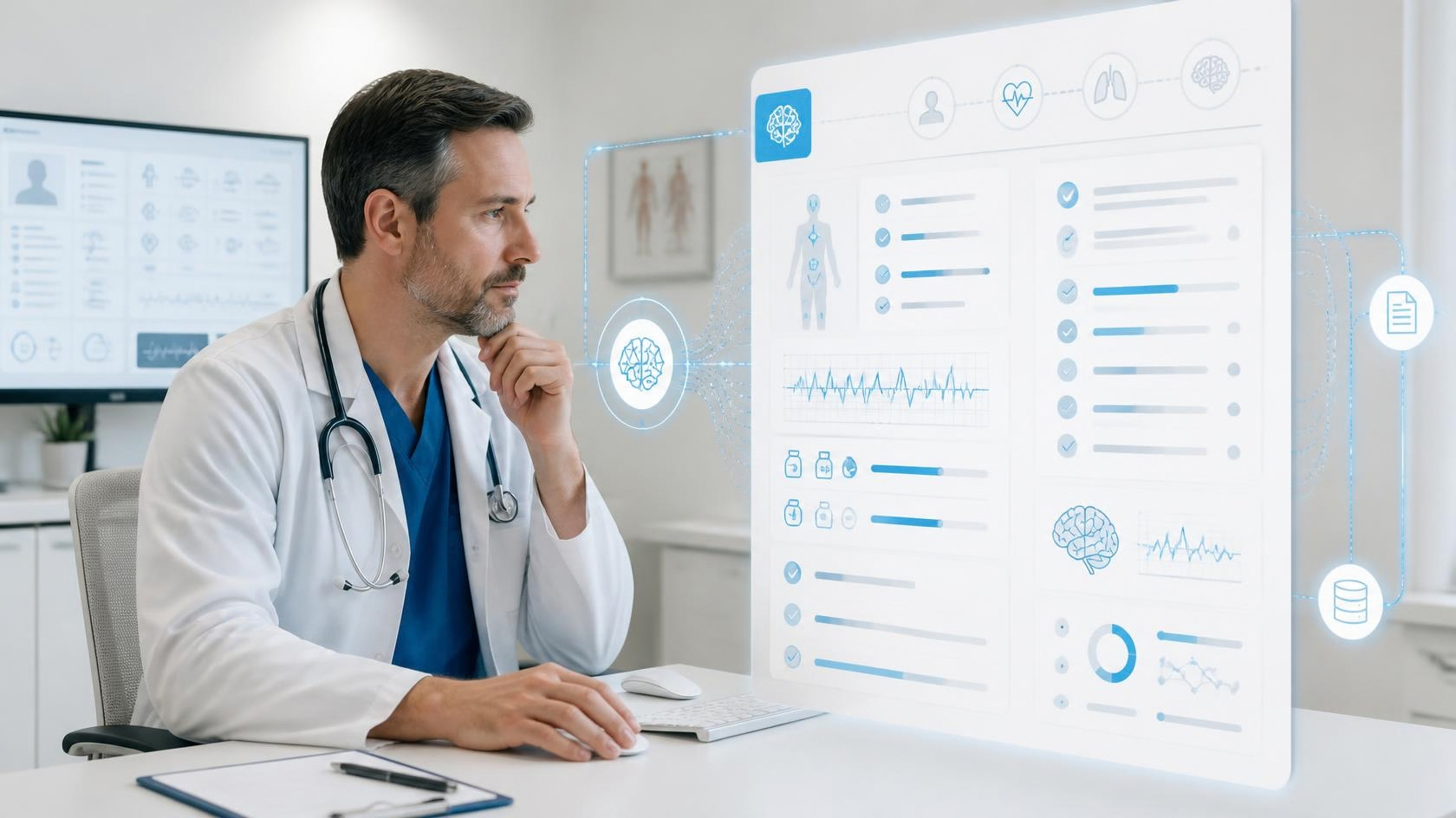
A product's name whether it includes "ambient," "AI medical," or simply "AI scribe" does not establish any of the following:
- Note accuracy, including performance on specialty-specific terminology
- Specialty coverage, since some systems perform well in primary care but inconsistently in cardiology, orthopedics, or behavioral health
- EHR compatibility, which varies by vendor and integration model
- Physician review requirements, since some systems produce near-final drafts while others require substantial editing
- Privacy and data security controls, including how conversations are stored, processed, and retained
- Customization options, such as note templates, specialty formats, or documentation preferences by provider
- Human review availability, which some practices require for quality assurance
- Implementation requirements, including onboarding time and training
These are not minor details. For a practice with active payer audits, specialty documentation requirements, or a high-volume physician schedule, any one of these factors can determine whether a documentation solution actually works in practice.
The
AI Medical Scribe Documentation Audit guide from Chase Clinical Documentation provides a structured framework for reviewing what AI-generated notes actually produce before committing to a platform.
Which Term Matters
When Evaluating a Solution?
The term a vendor uses should function as a starting point for questions, not as a conclusion. A practical decision framework:
If you are searching using "AI scribe" → Determine exactly which documentation functions are included. Does it generate complete notes or assist with editing? Is it designed for clinical encounters specifically?
If you are searching using "AI medical scribe" → Investigate clinical documentation capabilities: specialty support, note structure, EHR integration pathway, and what the physician review step looks like in practice.
If you are searching using "ambient AI" → Focus on the downstream output, not just the capture method. How are speaker roles distinguished? How is clinical context identified and organized? What note formats are produced?
If you are searching using "ambient medical scribe" → Verify both that ambient capture functions as described and that the clinical note generation meets your documentation requirements. These are two separate capabilities that should be evaluated independently.
The Chase Ezyscribe platform, for example, functions as an
AI medical scribe with ambient documentation capability capturing natural clinical conversations and generating structured encounter notes for physician review within an EHR-integrated workflow. That combination represents one implementation; other vendors structure the same capabilities differently.
Questions to Ask
Before Choosing an AI Scribe
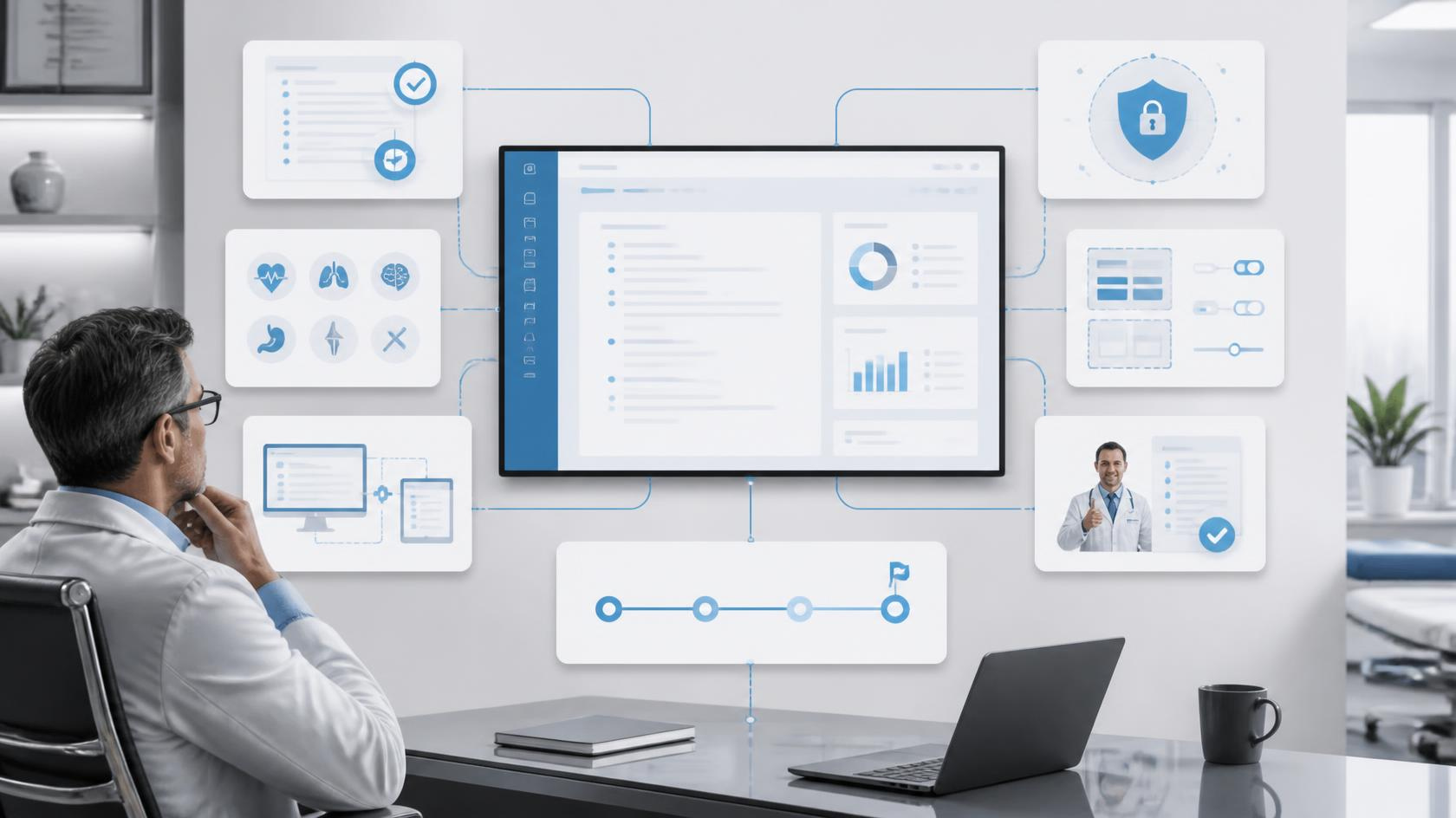
Before committing to any AI documentation solution, a practice should work through these questions:
- Does the system capture natural conversations, or does it require the physician to dictate or issue commands?
- How does the system distinguish between physician speech and patient speech?
- Which clinical note formats are supported, and can they be customized by specialty or provider preference?
- What does the physician review step look like and how much editing is typically required?
- Which EHR platforms does the system integrate with, and what does that integration actually include?
- How does the system perform on specialty-specific terminology for your clinical setting?
- What security and privacy controls govern how patient conversations are processed and stored?
- Is human review available as a quality layer, and if so, how does that process work?
No vendor answer to these questions should go unverified. Request documentation, trial access, or references from practices in your specialty before making a final decision.
The Bottom Line
The terminology surrounding AI clinical documentation reflects a fast-moving market where product categories are still being defined. "AI scribe," "AI medical scribe," and "ambient AI" are not standardized regulatory designations they are commercial and descriptive terms that overlap in practice and vary in meaning between vendors.
When evaluating
documentation technology for your practice, the productive question is not which label sounds most advanced. It is what the system actually captures, what it generates, how it integrates with your clinical environment, and what it requires of the physician before documentation is finalized. Those four questions will tell you far more than any product name.
FAQ
Is an AI medical scribe the same as an AI scribe?
Not exactly. "AI scribe" is a broad category covering any AI-assisted documentation. "AI medical scribe" is a more specific term indicating the system is designed for healthcare clinical documentation structured encounter notes, medical terminology processing, EHR integration, and physician review workflows. All AI medical scribes are AI scribes; not all AI scribes are built to function as medical-grade documentation tools.
Is ambient AI the same as an AI medical scribe?
No. Ambient AI describes a capture method passive, background listening during a natural patient-provider conversation. An AI medical scribe describes a documentation output structured clinical notes generated for physician review and EHR entry. A product can use ambient AI as its capture method and function as an AI medical scribe for output, but the two terms describe different components of the same pipeline, not the same thing.
What is an ambient medical scribe?
An ambient medical scribe combines ambient AI capture listening passively to natural clinical conversations with healthcare-specific note generation. The term implies both that the system does not require dictation and that the documentation output is structured for clinical use. Practices evaluating ambient medical scribes should verify both capabilities independently, since vendors use the term with varying degrees of specificity.
Does every AI scribe use ambient AI?
No. Some AI scribe products require physician dictation or structured commands to initiate note generation. Others are triggered by specific phrases or manual activation. Ambient capture where the system listens continuously without prompting is one implementation approach, not a defining feature of all AI scribe software.
Does an AI medical scribe replace a physician's documentation responsibility?
No. Regardless of terminology, all current AI documentation systems generate draft notes that require physician review, editing, and approval before becoming part of the patient's medical record. Physician responsibility for documentation accuracy is not altered by the presence of AI in the workflow.
What should a practice verify before choosing any AI documentation solution?
Beyond terminology, a practice should evaluate: note accuracy in your specific specialty, the extent of EHR integration, what the physician review step requires, how patient conversations are stored and protected, whether customization is available, and whether human review is an option. Platforms like Ezyscribe from Chase Clinical Documentation offer structured onboarding and specialty-specific configuration but any platform evaluated should be tested against your actual clinical environment before full adoption.
Recent Posts