Why Isn't My AI Medical Scribe
Saving Me Time?

You adopted an AI medical scribe expecting documentation to shrink to a fraction of its former burden. Instead, you are still finishing notes after clinic hours, still correcting errors, still spending mental energy on documentation when you should be done for the day. The technology is running. The notes are generating. So why doesn't it feel like anything has changed?
The answer is rarely simpleand almost never just "the AI doesn't work." Time savings from AI medical scribing depend on far more than whether a note gets produced at the end of an encounter. They depend on where the friction lives in your specific documentation workflow, how well the tool fits your clinical environment, and whether the implementation was designed to actually save physician time or just to generate output.
This article is a diagnostic. Not a pitch, not a product comparison. If your AI scribe isn't delivering the efficiency you expected, this is where to start.
The Six-Stage Documentation Chain — And Where It Breaks
Most physicians evaluate their AI scribe by looking at one thing: does it create a note? That is the wrong question. The right question is: at which stage of the documentation cycle is time being lost?
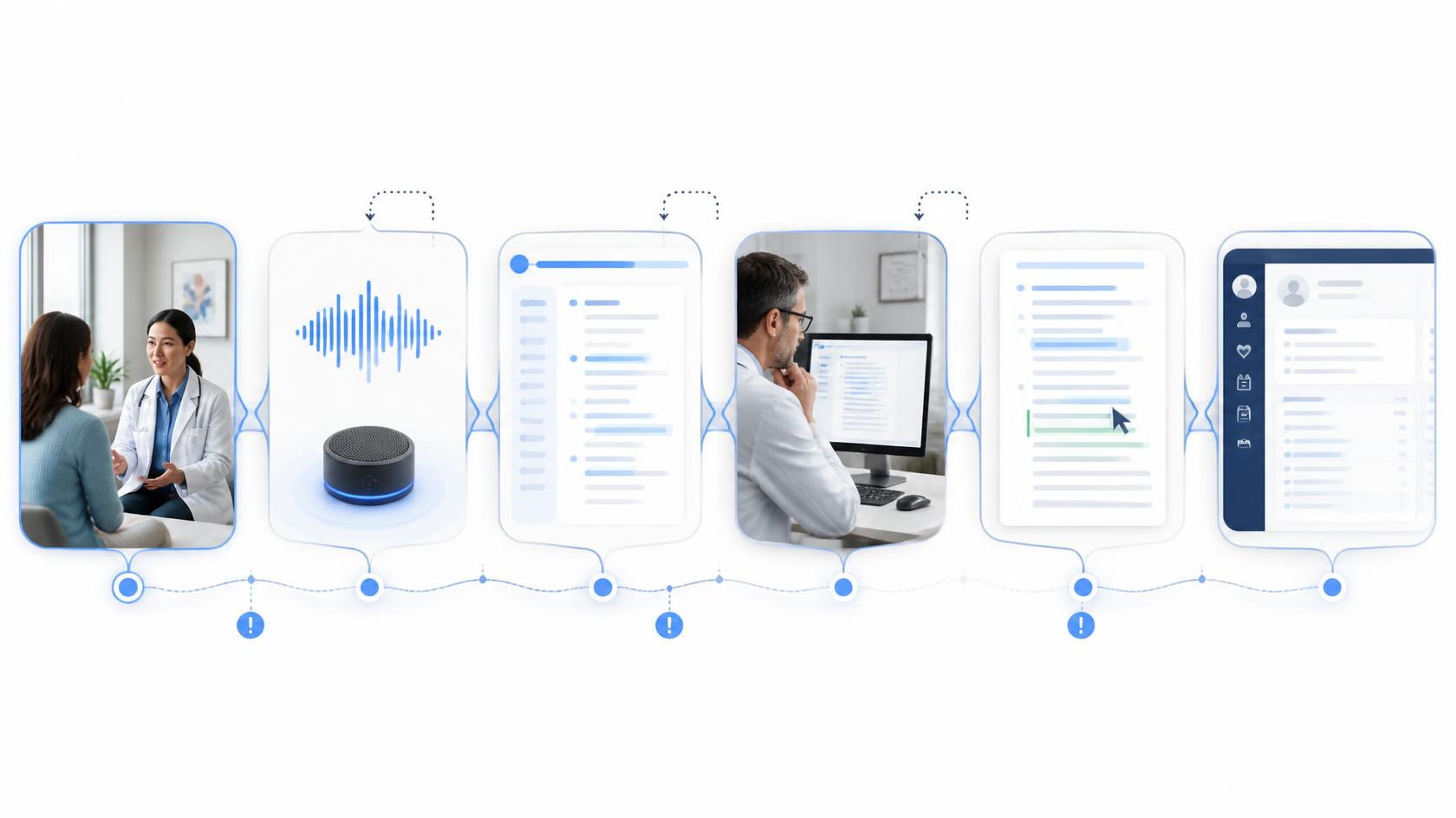
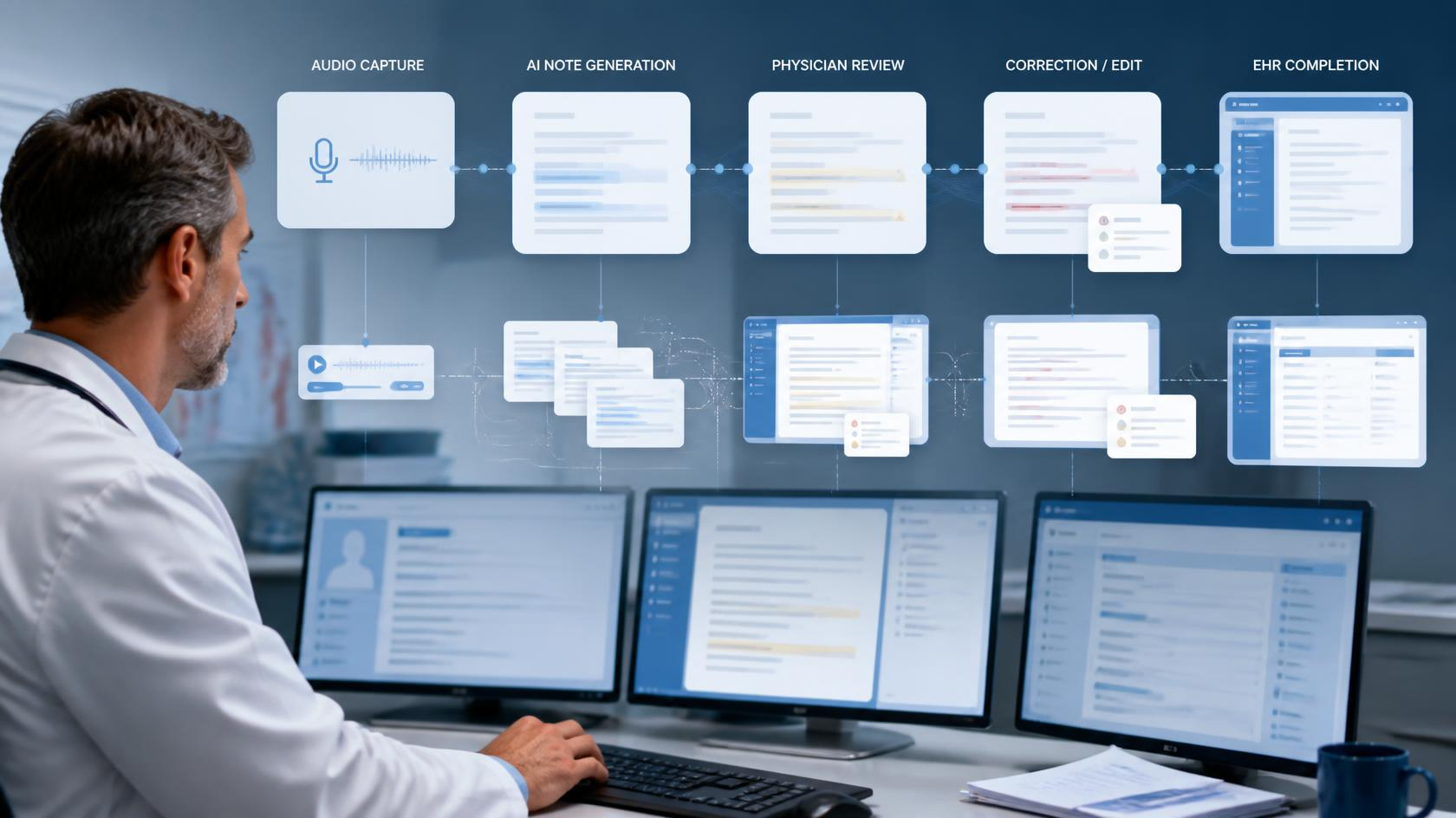
Think of clinical documentation as a six-stage chain:
Encounter → Capture → Note Generation → Review → Correction → EHR Completion
An AI scribe can perform flawlessly at the generation stage and still fail to save time at every other stage. Here is how each stage becomes a hidden time sink:
Encounter. If a physician's communication style doesn't naturally translate well to ambient AI capture talking quickly, using shorthand, layering several clinical points in one sentence the downstream note will be incomplete or disorganized before generation even begins. The problem starts here, not at the review stage where it eventually surfaces.
Capture. Ambient AI and AI scribe tools differ in what they capture and how. A tool optimized for general conversational capture may miss specialty-specific terminology, drop medication dosages discussed mid-sentence, or fail to distinguish clinical assessment from patient-reported history. Poor capture quality cannot be corrected at the generation stage it compounds.
Note Generation. This is where most physician expectations live. The assumption is that generation equals completion. It does not. Generation produces a draft, and the quality of that draft is the product of everything that came before it capture quality, template design, specialty customization, and how well the system has been configured for the physician's documentation style.
Review. This is the stage most practices underestimate. If a physician spends four to seven minutes reviewing and correcting a note for every encounter, the documentation burden has not been eliminated it has been restructured into a different kind of work. For a thirty-patient day, that is two or more hours of post-encounter review that was not factored into the original time-savings calculation.
Correction. Recurring errors are not random. They follow patterns: the same medication category gets dropped, laterality is consistently misassigned, the plan section omits follow-up timing. When corrections are not tracked and fed back into workflow or configuration adjustments, the same errors recur indefinitely and the physician repeats the same corrections indefinitely.
EHR Completion.
If the AI scribe does not integrate directly into the EHR or if note sections must be manually transferred, reformatted, or re-entered that transfer friction alone can consume several minutes per encounter. This is one of the most common and least-discussed reasons AI medical scribe adoption fails to reduce documentation time in practice.

Technology Problem or
Workflow Problem? How to Tell the Difference
Physicians experiencing persistent documentation inefficiency with an AI scribe often assume the technology is at fault. Sometimes that is correct. More often, the issue is implementation and the distinction matters because each requires a different response.
Signs the problem is your workflow, not the tool:
- Notes are accurate but you are still spending significant time on review because you have no structured, efficient review process
- The AI is capturing the encounter correctly, but copy-paste steps between the tool and your EHR are consuming the time saved elsewhere
- Your note templates are generic and require significant reformatting to match your specialty's documentation conventions
- The tool was deployed without customization to your preferred note structure, vocabulary, or assessment/plan format
- Physician behavior during encounters hasn't adapted clinical details that need to be verbalized clearly are still being left to context
Signs the problem is the technology:
- Capture accuracy is poor regardless of how clearly the encounter is conducted
- Specialty terminology is systematically misunderstood or omitted
- The EHR integration is nominal notes arrive in a non-editable state, require re-entry, or don't populate structured fields
- The note structure cannot be configured to reflect the physician's documentation requirements
- Review time has not decreased after sixty or more days of active use
The practical distinction: workflow problems can be fixed without changing tools. Technology limitations require either vendor engagement for meaningful product improvement or a reassessment of whether the tool is appropriate for the practice's clinical environment.
What an Efficient AI Scribe
Workflow Actually Looks Like
Practices where AI medical scribing genuinely reduces documentation time share a few characteristics that are rarely part of the vendor sales conversation.
The review process is structured and bounded. Physicians are not reading every word of every note from top to bottom. They review high-risk sections assessment, plan, medications, orders with a consistent checklist, and they have developed a sense of what the system captures reliably versus where it needs attention. Review time decreases over time because the physician knows where to look.
The tool is configured for the specialty, not for generic clinical documentation. A psychiatry note and an orthopedic surgery note have fundamentally different structures. An AI scribe deployed with default templates optimized for primary care produces output that requires significant reformatting in specialty environments. Configuration is not optional; it is the core of what makes the tool work.
EHR integration is true integration. The note populates the correct fields. The physician reviews and approves within the EHR rather than toggling between systems. The AI-generated content doesn't require reformatting before it is clinically usable.
Capture quality is treated as an ongoing optimization. Physicians periodically review where the AI is missing or misinterpreting information and adjust their communication habits accordingly not by sounding robotic, but by learning which clinical details benefit from deliberate verbalization during the encounter.
A Practical
Self-Evaluation Checklist
If your AI medical scribe is not delivering expected time savings, work through this diagnostic before drawing conclusions:
Capture and Generation
- Is the AI consistently capturing medication names, dosages, and changes discussed during the encounter?
- Is the assessment/plan section accurately reflecting clinical reasoning, not just summarizing patient-reported symptoms?
- Does the generated note match your specialty's documentation conventions without significant reformatting?
- Are you losing clinical content from encounters where multiple conditions or complex histories are discussed?
EHR Integration
- Does the note populate directly into your EHR in an editable format?
- Are structured data fields diagnoses, medications, orders populated from the AI note, or re-entered manually?
- How many steps does it take to go from a generated note to a signed, complete EHR record?
Review Process
- Do you have a defined, repeatable sequence for reviewing AI-generated notes, or do you read each one from scratch?
- Are you tracking how long review takes per encounter?
- Have you identified which sections of the note require consistent correction?
Recurring Errors
- Are the same types of errors appearing repeatedly in generated notes?
- Have those patterns been communicated to the vendor or used to adjust the workflow?
- Is there a feedback mechanism in place, or is each correction made in isolation?
If you answered no to most of these questions, the issue is almost certainly implementation and workflow not the AI itself.
When AI Scribing
Alone Isn't the Right Answer
For some practice environments, AI medical scribing solves part of the documentation problem but not all of it. High-complexity encounters patients with extensive histories, multi-system conditions, overlapping conditions, or significant psychosocial context often produce AI-generated notes that require enough correction that the efficiency benefit is limited.
In these situations, a hybrid model may reduce documentation burden more effectively than AI scribing alone. Some practices use AI scribing for routine encounter types while relying on human virtual scribe support for complex cases. Others layer AI documentation tools with medical transcription for certain encounter categories. The goal is documentation efficiency across the full range of encounter types, not uniform adoption of a single tool.
The question is not "which tool is better?" It is "which approach produces accurate, complete documentation in the least amount of physician time across the encounters that actually make up this practice's day?"
The Summary
An AI medical scribe does not save time by generating a note. It saves time when the note generated is accurate enough, structured correctly, and delivered into the EHR in a way that requires minimal correction and no manual transfer. Every gap in that chain costs time and those gaps don't disappear on their own.
If your documentation burden hasn't decreased, the cause is findable. It is almost always somewhere in the six-stage chain, and it is almost always addressable before you conclude the tool simply doesn't work.
For practices that have worked through the diagnostic and determined that AI scribing alone isn't sufficient for their documentation volume or encounter complexity,
Chase Clinical Documentation offers AI medical scribe solutions,
virtual medical scribe services, and
hybrid documentation support designed around how your practice actually operates not how a vendor assumes it does.
FAQ
Why does my AI scribe produce accurate notes but still take a long time to review?
Review time is often less about note accuracy and more about the absence of a structured review process. Physicians who read every note in full, from the top, spend significantly more time in review than those who have learned to focus on high-risk sections assessment, plan, medications, and any clinical detail that was complex or time-sensitive during the encounter. Developing a consistent review checklist can reduce review time substantially even when note quality stays constant.
Is ambient AI the same thing as an AI medical scribe?
Not exactly. Ambient AI generally refers to technology that passively listens to clinical conversations and generates documentation without requiring dictation or input commands. An AI medical scribe may use ambient AI as its capture mechanism, but the term encompasses the broader workflow capture, note generation, structure, EHR delivery, and review. The distinction matters because ambient capture quality varies significantly across tools and clinical environments.
Why is my AI scribe missing key clinical details even during clear encounters?
Most commonly, this reflects one of three issues: the tool's natural language processing has gaps in specialty-specific terminology; the note template is not structured to capture the type of detail that matters in your clinical context; or the AI is interpreting clinical context rather than explicit clinical statements. For example, a medication dosage mentioned once in passing during a complex encounter is more likely to be captured accurately if verbalized clearly"starting lisinopril ten milligrams daily"than if it emerges from discussion context.
My AI scribe note looks good but I still have to re-enter information into the EHR. Is this normal?
It is common but not acceptable as a permanent state. When AI-generated notes require manual transfer or re-entry into EHR fields, the integration is incomplete. This is a meaningful source of documentation inefficiency that should be addressed through vendor support or by reassessing whether the tool integrates with your EHR in a clinically usable way.
How long should it take before an AI scribe starts saving meaningful time?
For physicians with a consistent encounter style in a well-configured implementation, meaningful time savings typically emerge within four to eight weeks of active use. If documentation time has not decreased after sixty days and if you have a structured review process in placeb it is worth examining whether the tool is appropriately configured for your specialty and EHR environment.
Should I consider switching tools, or try to fix my current workflow first?
Fix the workflow first. Most AI medical scribe implementations that underperform do so because of configuration gaps, incomplete EHR integration, or the absence of a structured review process not because the underlying technology is unsuitable. Switching tools resets the learning curve without necessarily addressing the root cause. Work systematically through the checklist above before drawing conclusions about the technology.
Recent Posts