How AI Medical Scribes Save
Doctors Time Throughout the Workday

It is 6:12 p.m. The last patient left the exam room forty minutes ago. A family medicine physician sits at her desk with nine charts still open, three unfinished progress notes, and two SOAP notes she started during lunch that never got completed. Tomorrow's schedule begins at 8:00 a.m.
This is not an unusual evening. It is a predictable outcome of a documentation structure where clinical care and note completion are treated as sequential activities rather than parallel ones.
The question physicians are increasingly asking is not whether AI scribing technology exists. It is: where, precisely, does an AI Medical Scribe actually return time during a working clinical day?
The answer is not a single dramatic shortcut. It is an accumulation of smaller recoveries distributed across every phase of the day.
The Documentation Time Doctors Lose Across a Typical Clinic Day
Documentation time is not a single block on a physician's schedule. It is fragmented across the day in ways that are easy to underestimate.
Physicians encounter documentation pressure at multiple distinct points:
- Writing or completing notes from the previous session before the first patient arrives
- Manually typing or dictating during or immediately after each encounter
- Using the brief gaps between appointments to catch up on notes from earlier visits
- Completing and signing charts during or after administrative periods
- Carrying unfinished documentation into the evening
Each of these moments represents a different category of documentation work. An AI Medical Scribe can reduce the manual effort involved in several of them though actual time recovered depends on factors including specialty, encounter volume, note complexity, existing documentation habits, and how thoroughly the physician reviews and refines AI-generated drafts.
Before the
Next Patient Arrives
A clinic day rarely starts clean. Physicians frequently begin seeing patients while carrying unfinished notes from the prior session or the previous day. That documentation carryover creates a kind of clinical debt one that accumulates interest throughout the day.
When AI-assisted documentation is used consistently, the encounter-to-draft interval narrows significantly. Rather than beginning the day with several notes still requiring manual construction, a physician may begin with drafts already generated from the previous session's encounters. The remaining task shifts from writing to reviewing a materially different cognitive activity that can take less time.
That distinction matters before 8:00 a.m. more than most documentation conversations acknowledge.
During Back-to-Back Patient Encounters
During a patient visit, a physician is simultaneously conducting a clinical assessment, directing the conversation, processing patient responses, and in a traditional workflow attempting to document concurrent with care.
The practical tradeoffs are familiar: typing while patients speak splits attention, dictating after the fact adds time, and deferring note creation entirely means documentation accumulates for later.
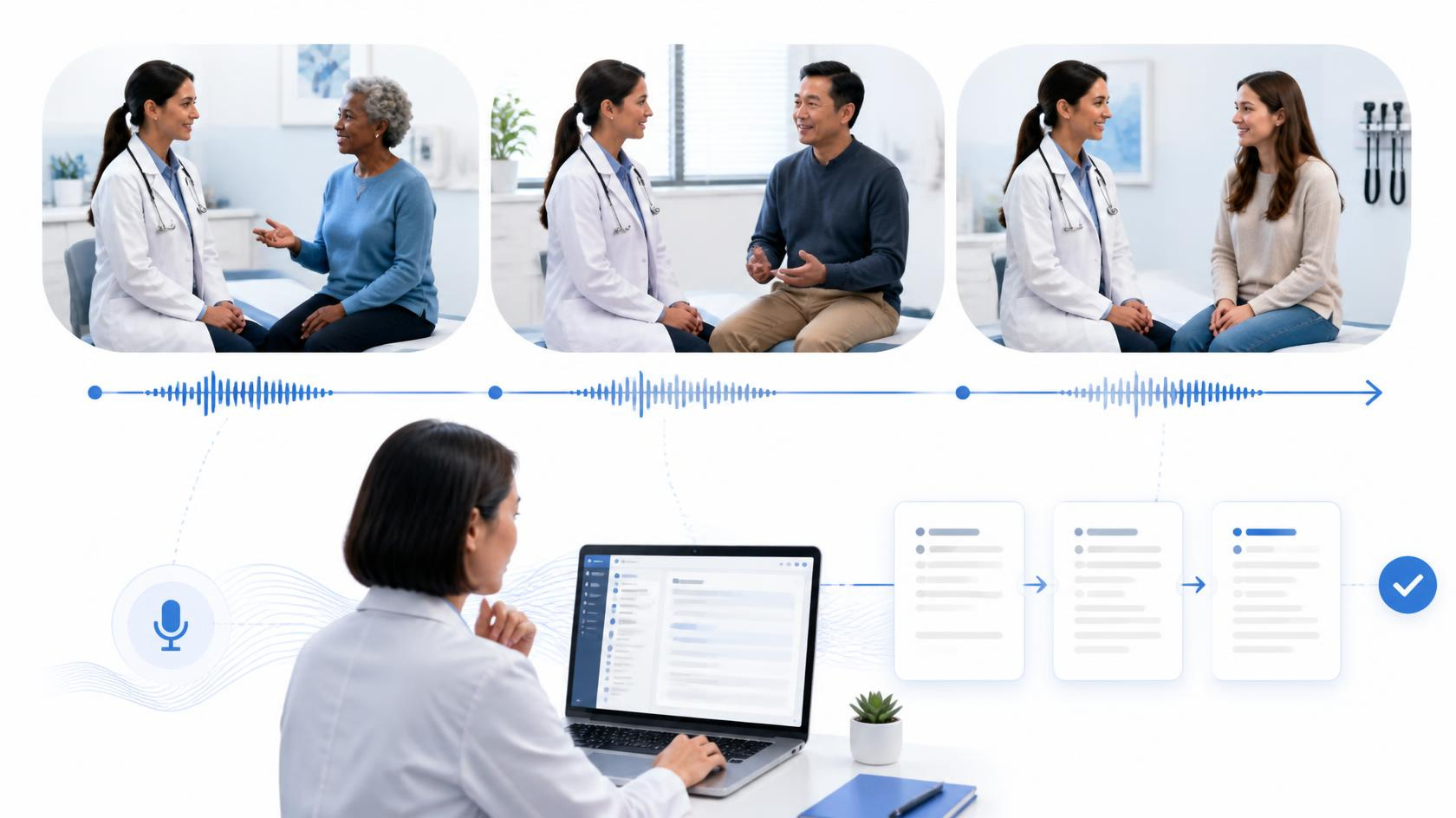
An AI Medical Scribe captures clinical encounter information as the visit unfolds and generates a structured draft for physician review. This shifts the physician's role from author to reviewer. Instead of composing a note, the physician reads, corrects, and approves one.
That shift does not eliminate review time. The physician remains responsible for the accuracy of every clinical note and must read each draft carefully before signing. But composing a clinical note from scratch and reviewing a structured draft are different tasks and that difference compounds across twenty or more encounters in a day.

The Hidden Minutes
Between Appointments
The five to eight minutes between patient appointments are often treated as documentation time by default. In a busy clinic, that assumption quietly shapes the entire day.
When those intervals are consumed by note catch-up, a physician may arrive at the next exam room without having reviewed the upcoming patient's chart, checked relevant lab results, or communicated a time-sensitive finding to staff.
Reducing repetitive note-entry tasks during those gaps not by eliminating the physician's review responsibility, but by providing a draft that requires less manual construction can help preserve inter-appointment intervals for genuinely clinical activities. Whether that recovered time goes toward chart review, result interpretation, or direct patient preparation depends on the practice, the day, and the physician. The point is that the option exists.
From First Draft
to Completed Chart
Generating a draft note and finalizing a clinical note are not the same activity.
An AI Medical Scribe produces a structured first draft from the patient encounter. That draft requires physician review, clinical judgment, and correction where needed. What it does not require, in most cases, is the manual construction of every sentence, the formatting of each SOAP section, or the recall of every detail from a visit that ended ninety minutes ago.
The time physicians lose to chart completion often comes less from the review itself than from the drafting, formatting, and memory reconstruction that precede the review. Reducing those preceding steps without reducing the rigor of physician oversight is where AI scribing can create meaningful efficiency within a
well-configured AI medical scribe workflow.
What Happens to
After-Hours Charting?
For many physicians, after-hours charting is not a scheduling failure. It is a structural inevitability of a documentation model that cannot keep pace with clinical volume during the workday.
Consider two conceptual patterns:
Documentation-heavy day without AI assistance: Patient visits → notes deferred → brief catch-up attempts between patients → documentation accumulates → post-clinic charting → after-hours documentation → incomplete charts carried forward
AI-assisted documentation day: Patient visits → AI captures encounter and generates draft → physician reviews draft closer to the encounter → chart approaches completion → less documentation carried into the evening
The objective of AI scribing is not to eliminate after-hours work entirely. Physicians will always have clinical responsibilities that extend beyond scheduled hours. The objective is to reduce the volume of manual documentation that has not yet been touched when the clinical day ends.
Even a partial reduction in that backlog represents meaningful time recovery particularly for physicians managing high encounter volumes or complex documentation requirements.
A Hypothetical Physician Workday With AI-Assisted Documentation
The following is a hypothetical illustration. It does not represent a clinical study, a verified average, or a guarantee of specific outcomes.
A primary care physician sees 22 patients in a clinic day. In a traditional workflow, that physician might spend an average of five to eight minutes per encounter on manual note construction whether during the visit, immediately after, or during catch-up periods. That accumulates to roughly two to three hours of documentation activity distributed across the day, with several charts often remaining incomplete at clinic's end.
With an AI Medical Scribe generating a structured draft from each encounter, the physician's per-encounter documentation role shifts toward review and approval. If review time averages two to four minutes per note for a well-generated draft, the total documentation activity across the same 22 encounters is materially reduced and a greater proportion of charts are closer to completion before the physician leaves the building.
The actual reduction varies by physician, by specialty, and by how carefully each draft requires correction. The pattern shifting from drafting to reviewing is the mechanism through which time can be recovered.
For practices evaluating this shift,
Chase Clinical Documentation's AI Medical Scribe service combines AI-generated drafts with a dedicated human editing layer, so physician review is supported rather than isolated.
Where Recovered Time Can Go
When documentation pressure decreases at multiple points throughout the day, the recovered time does not automatically redistribute to any single activity. Physicians choose where it goes based on their clinical priorities.
Possibilities include:
- More complete attention during patient encounters, without divided focus on note creation
- Chart review and preparation before complex appointments
- Timely follow-up on pending lab results or specialist communications
- Reduced documentation carried into personal evening hours
- Earlier chart completion, closer to the encounter when clinical details are clearest
The American Medical Association has identified physician administrative burden particularly EHR documentation as a primary driver of burnout and reduced professional satisfaction. While an AI Medical Scribe is not a burnout solution by itself, reducing the cumulative documentation load across a physician's day addresses one of the most consistently identified contributors to that burden.

What AI Medical Scribes Do —
and What Physicians Still Own
An AI Medical Scribe does not make clinical decisions. It does not determine diagnoses, select treatment plans, or exercise medical judgment of any kind. It generates a structured documentation draft from a clinical encounter.
The physician reviews that draft. The physician corrects it where it is inaccurate, incomplete, or inconsistent with the clinical record. The physician signs it and takes responsibility for its contents.
Physicians who want to understand how that review responsibility fits into the broader documentation workflow may find Chase's guidance on training physicians to use an AI Medical Scribe effectively useful as a practical reference. For practices evaluating both AI and human scribing options, the virtual medical scribe service provides an alternative model where a remote human scribe manages documentation in real time.
The value of AI scribing is not that it removes the physician from the documentation process. It is that it changes the physician's role within that process from primary author to clinical reviewer across every encounter in the day.
That change, multiplied across a full clinic schedule, is where the cumulative time recovery occurs.
FAQ
How do AI medical scribes save doctors time?
An AI Medical Scribe captures patient encounter information and generates a structured clinical note draft for physician review. Rather than manually composing each note, the physician reads, corrects, and approves a draft. This shift from authoring to reviewing can reduce the time spent on note creation across multiple points of the workday before clinic, between patients, and at the end of the day.
How much time can an AI medical scribe save a physician?
Actual time savings vary based on specialty, encounter volume, note complexity, documentation habits, and how thoroughly AI-generated drafts require correction. Physicians seeing high encounter volumes with relatively consistent note formats may see greater cumulative reduction than those with highly complex or variable documentation requirements. No fixed saving applies universally.
Can an AI medical scribe help during busy back-to-back clinic schedules?
Yes. During consecutive patient visits, an AI Medical Scribe can capture encounter information and produce a structured draft, allowing the physician to maintain focus on the patient rather than on simultaneous note creation. The reduction in manual documentation activity between patients may also help preserve inter-appointment time for clinical review rather than catch-up charting.
Do physicians still need to review AI-generated notes?
Yes, always. The physician is responsible for the accuracy and completeness of every clinical note. AI-generated drafts require careful physician review, clinical judgment, and correction where needed before signing. AI scribing reduces the drafting workload; it does not replace physician oversight of the final documentation.
Where does an AI medical scribe save the most time across the workday?
The most consistent time savings tend to occur in two areas: immediately after patient encounters, where draft availability reduces manual note construction, and at the end of the clinical day, where fewer incomplete charts remain for after-hours completion. The aggregate effect across a full schedule is typically greater than the savings at any single point in the day.
Recent Posts