Medical Terminology Every
Virtual Medical Scribe Should Know

A virtual medical scribe helps healthcare providers document patient encounters by organizing clinical information into structured medical records. To perform this role effectively, a virtual medical scribe must understand common medical terminology, SOAP notes, history of present illness (HPI), review of systems (ROS), physical examination findings, assessment and plan sections, and electronic health record (EHR) documentation. Accurate terminology and careful documentation support clear clinical communication while leaving medical decisions to the treating provider.
Why Medical Terminology Matters for Virtual Medical Scribes
Medical terminology provides a consistent language for documenting symptoms, examination findings, medical history, diagnoses, and treatment plans. A virtual medical scribe who understands this language can better follow a clinical encounter, organize information, and identify documentation that needs clarification from the provider.
Virtual medical scribe duties may include recording the patient's reported concerns, documenting relevant history, organizing examination findings, and entering information into the appropriate EHR sections according to practice protocols.
- Medical terminology knowledge is especially important when:
- Documenting
similar-sounding medical terms that have different meanings.
- Distinguishing a patient-reported symptom from an observed clinical finding.
- Recording negative findings without changing their meaning.
- Using approved abbreviations consistently.
- Preserving the provider's intended clinical meaning.
- Identifying unclear or conflicting information for clarification.
A
medical scribe supports the documentation process. The treating clinician remains responsible for clinical interpretation, diagnosis, treatment decisions, and review and approval of the medical record.
Medical terminology helps a virtual medical scribe accurately document patient symptoms, medical history, examination findings, and treatment plans while preserving the clinician's intended meaning.

Essential Medical Terminology
Every Virtual Medical Scribe Should Know
1. Chief Complaint (CC)
The chief complaint is the primary reason a patient seeks medical care. It is commonly documented near the beginning of an encounter note.
Example:
“Persistent cough for three days.”
The scribe should accurately record the patient's stated concern or the provider's documented reason for the visit without adding symptoms or assumptions.
2. History of Present Illness (HPI)
The history of present illness describes the development and characteristics of the patient's current concern. Depending on the encounter, it may include onset, location, duration, severity, timing, context, associated symptoms, and factors that improve or worsen the condition.
Example: A patient reports a cough that began three days ago, is worse at night, and is accompanied by mild throat discomfort.
The scribe should capture the information actually reported or elicited during the encounter. Missing details should not be invented to complete a template.
3. Review of Systems (ROS)
The review of systems records information about symptoms across relevant body systems. It may include constitutional, cardiovascular, respiratory, gastrointestinal, musculoskeletal, neurological, and other systems.
Example: “Respiratory: Reports cough. Denies wheezing.”
The scribe must preserve the scope of the review. A negative finding for one symptom does not mean that every symptom in that system is absent.
4. Physical Examination (PE)
The physical examination documents findings observed or elicited by the clinician.
Examples of terminology include:
- Inspection:
Visual examination of a body area.
- Palpation:
Examination using touch.
- Auscultation:
Listening to internal body sounds, often with a stethoscope.
- Edema:
Swelling caused by fluid accumulation in tissues.
- Erythema: Redness of the skin or another tissue.
- Tenderness: Pain or discomfort elicited by touch or pressure.
A scribe should document the clinician's findings as communicated. A patient-reported symptom must not be converted into an examination finding.
5. Assessment and Plan (A&P)
The assessment summarizes the clinician's evaluation of the patient's condition. The plan records the intended next steps, which may include testing, medication management, counseling, referrals, or follow-up.
For example, a provider may document an assessment of a respiratory condition and a plan to order testing and arrange follow-up.
The scrie records the provider's assessment and plan. They must not independently create a diagnosis, recommend treatment, or modify the plan.
6. Past Medical, Surgical, Family, and Social Histor
These sections provide background relevant to the patient's care.
- Past medical history (PMH): Previously diagnosed or documented medical conditions.
- Past surgical history (PSH):
Previous surgical procedures.
- Family history (FH):
Relevant health conditions among family members.
- Social history (SH): Relevant information such as tobacco use, alcohol use, occupation, or living circumstances, when collected and documented.
Information should be placed in the correct section and attributed appropriately. A family member's condition, for example, should not be recorded as a diagnosis belonging to the patient.
7. Vital Signs
Vital signs are measurements used to assess basic physiological functions. Common examples include:
- BP: Blood pressure.
- HR:
Heart rate.
- RR:
Respiratory rate.
- SpO₂: Peripheral oxygen saturation.
- Temp:
Temperature.
Values, units, and context should be preserved as documented. A scribe must not estimate missing measurements or change units without an approved workflow.
8. Differential Diagnosis and Clinical Findings
A differential diagnosis is a clinician's consideration of possible explanations for a patient's presentation. Clinical findings are information obtained through history, examination, and relevant investigations.
These terms are not interchangeable with a confirmed diagnosis. A scribe should accurately capture the provider's wording and distinguish possibilities from established conclusions.
| Section | What it means | Typical content |
|---|---|---|
| Subjective | Information reported by the patient or another source | Chief complaint, HPI, relevant symptoms |
| Objective | Measurable or observed information | Vital signs, examination findings, available test results |
| Assessment | The clinician's evaluation | Diagnoses or clinical impressions documented by the provider |
| Plan | Intended next steps | Testing, treatment, counseling, referrals, follow-up |
Medical terminology helps virtual medical scribes organize patient-reported information, observed findings, the clinician's assessment, and the plan into the correct SOAP note sections.
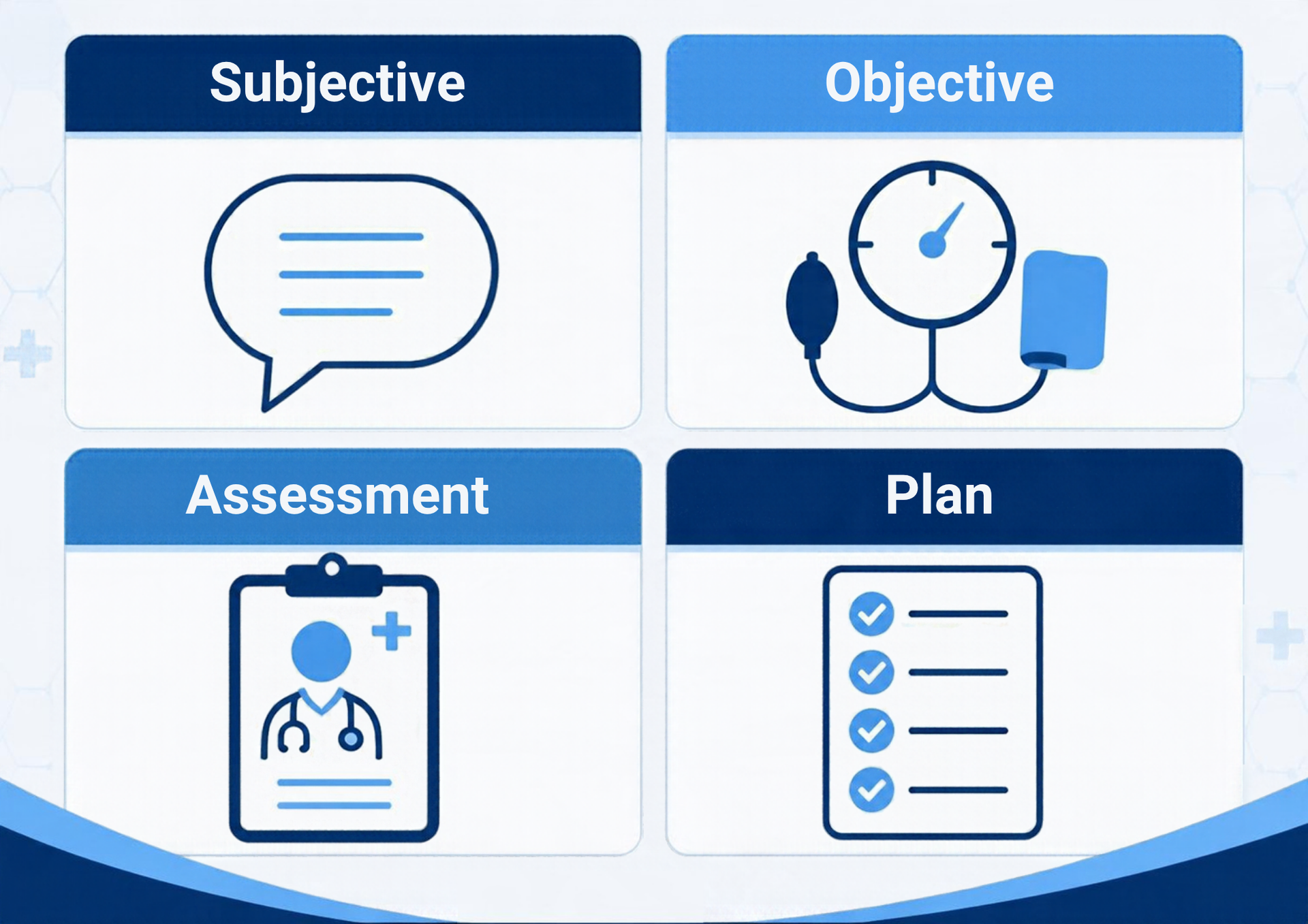
Example of a SOAP Note
The following example is fictional and illustrates documentation structure only.
S — Subjective: Patient reports a three-day cough and mild throat discomfort. Cough is worse at night.
O — Objective: Temperature and other examination findings should be entered only when actually obtained and communicated by the clinician.
A — Assessment: Document the clinician's stated assessment. Do not infer a diagnosis from the reported symptoms.
P — Plan: Record the provider's specified testing, treatment, and follow-up instructions.
The example deliberately
avoids assigning a diagnosis or inventing clinical findings. In an actual encounter, the note must reflect the complete information available to the treating provider.

A virtual medical scribe organizes encounter details into the appropriate EHR sections, uses approved medical terminology, checks for documentation errors, flags unclear information, and routes notes for clinician review according to the practice's workflow.
EHR Documentation and
the Virtual Medical Scribe Workflow
An electronic health record is a digital record of a patient's health information. EHRs can contain medical history, diagnoses, medications, progress notes, test results, allergies, and other information relevant to care.
For a virtual medical scribe, accurate EHR documentation involves more than typing what was said. Information must be organized in the correct sections and handled according to the practice's procedures.
A practical clinical documentation workflow includes:
- Review the encounter context.
Follow the provider's authorized workflow and verify the correct patient and encounter.
- Capture relevant information.
Record the patient's reported history and the clinician's communicated findings.
- Organize the note.
Place information in the appropriate HPI, ROS, examination,
assessment, and plan sections.
- Use terminology carefully.
Apply approved abbreviations and preserve the meaning of clinical statements.
- Flag uncertainty. Seek clarification through the established workflow when information is incomplete, inconsistent, or unclear.
- Complete a documentation check. Review for missing sections, incorrect placement, transcription errors, and inconsistencies.
- Route for clinician review. Follow the practice's process for provider review, correction, and approval before finalization.
The precise
workflow depends on the provider's instructions, the EHR, and the services authorized for the scribe. Direct EHR access, integrations, and note-finalization permissions should never be assumed.
Medical Scribe Best Practices for Accurate Documentation
Preserve clinical meaning
A scribe should not replace a provider's wording with a different clinical interpretation. When a statement is unclear, flag it for clarification rather than making an unsupported assumption.
Distinguish reported symptoms from observed findings
Patient statements belong in the appropriate subjective section. Examination findings should reflect what the clinician observed or communicated.
Document relevant negatives accurately
Terms such as “denies,” “negative for,” and “not assessed” do not mean the same thing. Do not convert an unasked question into a negative finding.
Avoid unsupported additions
Never invent vital signs, diagnoses, examination findings, medication instructions, or follow-up recommendations. Do not fill empty fields with assumptions simply to make a note appear complete.
Use approved abbreviations
Follow the practice's standards and consider specialty-specific terminology. Avoid abbreviations that could be misinterpreted.
Protect patient information
Virtual medical scribing involves access to sensitive health information. Organizations should assess authorized access, secure communication, training, contractual arrangements, and applicable privacy and security safeguards. HIPAA obligations depend on the parties and services involved; a
business associate agreement alone does not establish complete compliance.

Human Virtual Medical Scribes vs.
AI Medical Scribes
Human virtual medical scribes and
AI medical scribe tools can both
support clinical documentation, but their workflows differ.
| Consideration | Human virtual medical scribe | AI medical scribe |
|---|---|---|
| Documentation method | A person documents the encounter remotely | Software generates documentation from captured information |
| Context handling | Can ask for clarification when the workflow permits | May require correction when speech or context is misinterpreted |
| Review requirements | Provider review remains essential | Generated notes also require appropriate human review |
| Workflow fit | Depends on staffing, communication, and scheduling | Depends on software capability, configuration, and EHR workflow |
| Key evaluation criteria | Training, accuracy processes, privacy controls, and availability | Output quality, security, integration, oversight, and error handling |
Neither model should be assumed to eliminate documentation errors.
Practices should evaluate the actual service,
establish review procedures, and confirm that the workflow meets their clinical, operational, and privacy requirements.
How Virtual Medical Scribe Services Support Healthcare Providers
Virtual medical scribe services can support physicians and healthcare teams by helping organize encounter information, prepare clinical notes, and maintain documentation workflows. Their usefulness depends on the practice's documentation needs, communication processes, and quality controls.
When evaluating a service, consider:
- Experience with the terminology
used in your specialty.
- Training and quality-review procedures.
- Compatibility with the practice's authorized EHR workflow.
- Procedures for correcting errors and escalating unclear information.
- Privacy and security safeguards appropriate to the data handled.
- Clear responsibilities for the scribe, provider, and service organization.
Chase Clinical Documentation
offers virtual medical scribe support as part of its clinical documentation services. Practices
interested in outsourcing documentation can discuss their workflow requirements with the Chase team before deciding whether the service is suitable.
No. High-stakes conversations involving diagnosis, consent, treatment decisions, or emergencies may require a qualified interpreter, depending on applicable requirements and clinical circumstances.
Conclusion
Medical terminology is fundamental to accurate virtual medical scribing. Understanding HPI, ROS, SOAP notes, physical examination findings, vital signs, and common abbreviations helps scribes organize patient encounter information without changing the clinician's intended meaning.
For healthcare practices considering documentation support, the priority should be a reliable workflow with clear responsibilities, appropriate safeguards, and consistent provider review.
Need support with clinical documentation? Contact Chase Clinical Documentation to discuss your practice's virtual medical scribe requirements.
FAQ
What medical terminology should a virtual medical scribe know?
A virtual medical scribe should understand common terms used in patient histories, review of systems, physical examinations, vital signs, assessments, and treatment plans. Familiarity with SOAP notes, HPI, ROS, and approved medical abbreviations is particularly useful.
What does HPI mean in medical documentation?
HPI stands for history of present illness. It describes the patient's current concern, including relevant details such as onset, duration, severity, associated symptoms, and factors that worsen or relieve the problem.
What is the difference between HPI and ROS?
HPI focuses on the development and characteristics of the primary concern. ROS records relevant symptoms across the body systems reviewed during the encounter.
What are SOAP notes used for?
SOAP notes organize clinical documentation into Subjective, Objective, Assessment, and Plan sections. This structure helps separate patient-reported information, observed findings, the clinician's evaluation, and the intended next steps.
Can a virtual medical scribe diagnose a patient?
No. A virtual medical scribe documents information and the clinician's stated assessment according to the authorized workflow. Diagnosis, treatment decisions, and clinical responsibility remain with the appropriate licensed healthcare professional.
How can a practice choose a virtual medical scribe service?
A practice should assess terminology knowledge, documentation quality controls, EHR workflow compatibility, privacy safeguards, communication procedures, and provider review requirements. It should also confirm the specific services and capabilities offered before signing an agreement.
Recent Posts