How Virtual Medical Scribes
Support Complex Patient Histories

A 58-year-old patient arrives for a follow-up. She has Type 2 diabetes, hypertension, stage 3 chronic kidney disease, and a history of coronary artery bypass surgery. Her endocrinologist recently adjusted her medication. She has two new symptoms she wants to discuss today. Her chart spans twelve years. The visit is scheduled for twenty minutes.
The clinical decision-making is challenging but manageable. The documentation is a different problem entirely.
Why Complex Patient Histories Are Hard to Document
Standard patient encounters have a clear, manageable structure. Complex visits don't. When a patient carries multiple chronic conditions, an extensive medication list, and years of specialist involvement, the documentation challenge isn't just about volume it's about organization and clinical accuracy.
What makes a patient history complex?
A complex patient history typically involves multiple active diagnoses, prior surgeries or hospitalizations, ongoing specialist care, evolving medication regimens, documented allergies or adverse reactions, relevant family and social history, and prior diagnostic findings that still influence current care. During a single encounter, the physician must distinguish what's historical from what's current and document both accurately.
Physicians often carry that cognitive load through the entire encounter. They're listening, reasoning, and deciding while simultaneously trying to remember whether to note the nephrology consult from March or flag the recent lab trend in the assessment. When documentation falls behind, notes get finished after hours or important context gets compressed or lost.
According to the American Medical Association, physician burnout is closely tied to administrative burden, and documentation is consistently cited as one of the most time-consuming non-clinical tasks a physician faces.

The Scribe's Role: Turning a
Long History Into a Usable Clinical Record
There's a distinction that's easy to overlook: capturing information during an encounter is not the same as producing a usable clinical note.
A physician can gather all the right details from a patient and still walk away with fragmented documentation if there's no structured process for organizing it. This is where a virtual medical scribe provides meaningful support.
How does a virtual medical scribe handle complex patient histories?
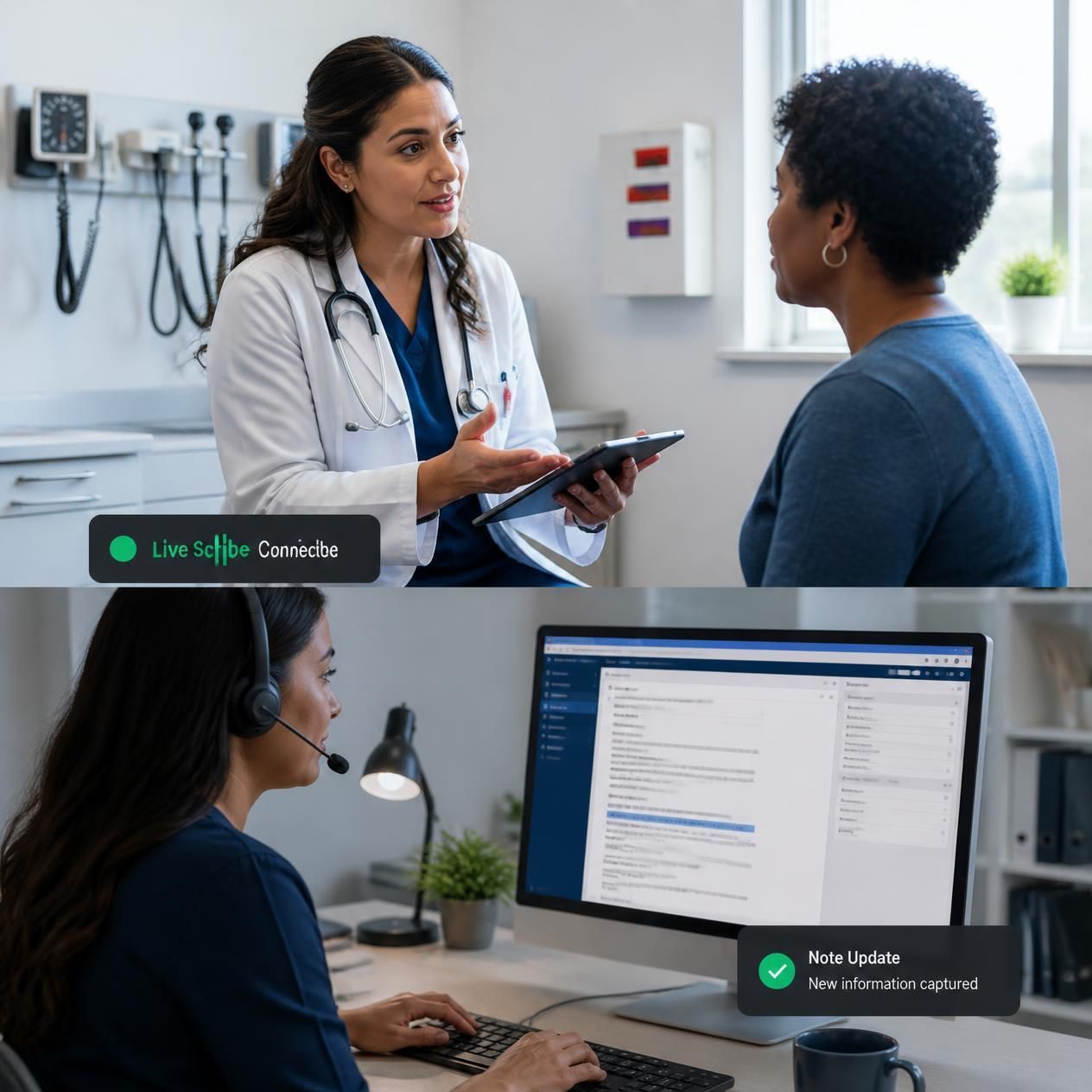
A virtual medical scribe listens to the physician-patient encounter in real time and drafts clinical documentation based on what's discussed. For complex visits, the scribe organizes relevant historical information, current complaints, medication updates, recent findings, and the physician's assessment and plan into a structured note typically in SOAP format or the practice's preferred template. The physician reviews and approves every note before it enters the medical record.
The scribe documents. The physician decides.
The workflow typically involves:
- Listening to the full physician-patient encounter via a secure connection.
- Identifying and organizing relevant historical, current, and contextual information.
- Drafting the clinical note in the physician's preferred format.
- Preparing the note for physician review before it enters the EHR.
- Leaving all clinical interpretation, diagnosis, and treatment decisions with the physician.
Follow the Journey of One Complex Visit
Consider a fictional patient call her Margaret, 64 seen in a general internal medicine practice.
Margaret has heart failure with reduced ejection fraction, atrial fibrillation managed with anticoagulation therapy, and a recent hospitalization for a fluid retention episode. She takes seven daily medications. Her cardiologist recently adjusted her beta-blocker dosage. Today she's reporting new fatigue and mild shortness of breath on exertion.
A lot of information needs to appear accurately in Margaret's note:
- Past history: Heart failure diagnosis date, prior hospitalization, cardiac history
- Current medications: Updated beta-blocker dose, anticoagulation status
- Current symptoms: Fatigue onset, exertional dyspnea details, any associated symptoms discussed
- Recent findings: Most recent echocardiogram results, labs reviewed during the visit
- Assessment: Physician's working impression
- Plan: Medication review, follow-up labs, referral or monitoring decisions
Without a scribe, the physician documents all of this typically after the patient has left. With a virtual medical scribe present during the encounter, the draft note is organized and ready for physician review by the time the visit ends.
That's where the time and workflow benefit actually comes from: not cutting corners, but eliminating the administrative reconstruction that happens after a complex visit.

What a Virtual Scribe Can
Help Keep Organized
A virtual medical scribe can support documentation across several areas of a complex encounter:
Medical History — Relevant diagnoses, prior surgeries, hospitalizations, and historical events discussed during the visit.
Medication History
— Current medications, recent changes, and any medication-related information raised by the physician or patient.
Current Symptoms — Presenting complaints, onset, duration, and symptom details as described during the encounter.
Clinical Context — Referenced lab results, imaging, or specialist findings discussed in the course of the visit.
Assessment and Plan — The structured framework for the physician's documented conclusions and next steps.
The physician remains responsible for clinical reasoning, diagnosis, treatment decisions, and final note approval at every stage.
Where Virtual Scribing
Adds the Most Value
Virtual scribing isn't equally useful across every type of encounter. It tends to provide the most workflow support in situations where documentation complexity is highest:
- New-patient consultations involving extensive intake history
- Chronic disease follow-ups with multiple active conditions
- Multi-problem primary care visits
- Specialist consultations requiring detailed historical context
- Medication management visits with evolving treatment plans
- Complex follow-ups where prior history is directly relevant to current decisions
The value also depends on how well the scribe understands clinical terminology, the physician's documentation preferences, and the specific EHR environment the practice uses. Implementation matters.

Human Expertise
Still Matters
Virtual medical scribes are documentation support not clinical decision-makers, and not a replacement for physician judgment.
The physician is responsible for:
- Clinical reasoning and differential diagnosis
- All treatment and medication decisions
- Reviewing, editing, and signing off on every note
- Medical decision-making at every level of the encounter
The scribe is responsible for:
- Listening and capturing encounter information accurately
- Organizing information into the physician's preferred documentation structure
- Drafting clinical notes for physician review
- Reducing the administrative component of documentation
This distinction matters for patient safety, compliance, and the integrity of the clinical record. A virtual medical scribe makes the documentation process more efficient but the physician's review and approval is always the final step.
What Practices Should Look For
If you're evaluating virtual medical scribe services for a complex practice environment, consider the following:
- Clinical terminology proficiency — Can the scribe accurately capture specialty-specific language without errors that require extensive correction?
- Experience with complex encounters — Has the service worked with multi-problem or longitudinal patient visits?
- EHR compatibility — Does the scribe's workflow align with your platform, whether that's Epic, Athenahealth, eClinicalWorks, or another system?
- HIPAA-conscious processes — What safeguards govern data handling, transmission, and storage?
- Physician review workflow — How does the scribe deliver drafts, and how efficiently can the physician review and approve?
- Specialty-specific experience — General scribing experience doesn't always translate well to cardiology, nephrology, or other subspecialties with distinct documentation requirements.
- Quality control — Does the service have processes in place to catch documentation errors before notes are reviewed?
No service will be a perfect fit for every workflow. The right question isn't "does
virtual scribing work?" it's "does this scribe service fit the way my practice actually operates?"
The Practical
Takeaway
Complex patient histories are not a documentation problem that can be solved by typing faster or spending more time after hours. They require organized, clinically relevant, encounter-driven documentation captured accurately and structured for both physician use and the broader care team.
A virtual medical scribe can support that process by handling the documentation layer so the physician can stay focused on the patient. When the encounter ends, the note is drafted, organized, and ready for review rather than starting from scratch at the end of a long day.
Chase Clinical Documentation provides virtual medical scribe services designed to support physicians across a range of specialties and practice settings. For practices exploring AI-assisted documentation options, Ezyscribe offers an AI medical scribe solution built to support clinical documentation workflows with physician oversight built in.
Complex visits deserve documentation that reflects the full clinical picture. A well-implemented scribing workflow can help make that possible.
FAQ
How does a virtual medical scribe handle complex patient histories?
The scribe listens for historical details, current symptoms, medication updates, and specialist findings, then organizes the information into the physician's preferred documentation format.
Can a virtual medical scribe help document chronic disease management visits?
Yes. A virtual scribe can capture and organize medication regimens, lab trends, specialist coordination, and longitudinal records during the visit.
Does a virtual medical scribe make clinical decisions?
No. Clinical reasoning, diagnosis, treatment decisions, and medical judgment remain with the physician.
What should physicians consider when selecting a virtual medical scribe service?
Important factors include clinical terminology proficiency, experience with complex encounters, EHR compatibility, HIPAA-conscious data handling, physician review workflows, quality control, and specialty-specific experience.
Can virtual medical scribes support specialist practices?
Yes, though the fit depends on the specialty and the service's experience. Specialties such as cardiology, nephrology, endocrinology, and oncology involve complex, longitudinal patient histories that generate detailed documentation needs. A virtual scribe service with specialty-specific experience and strong clinical terminology knowledge is better positioned to support these environments than a generalist service.
Recent Posts