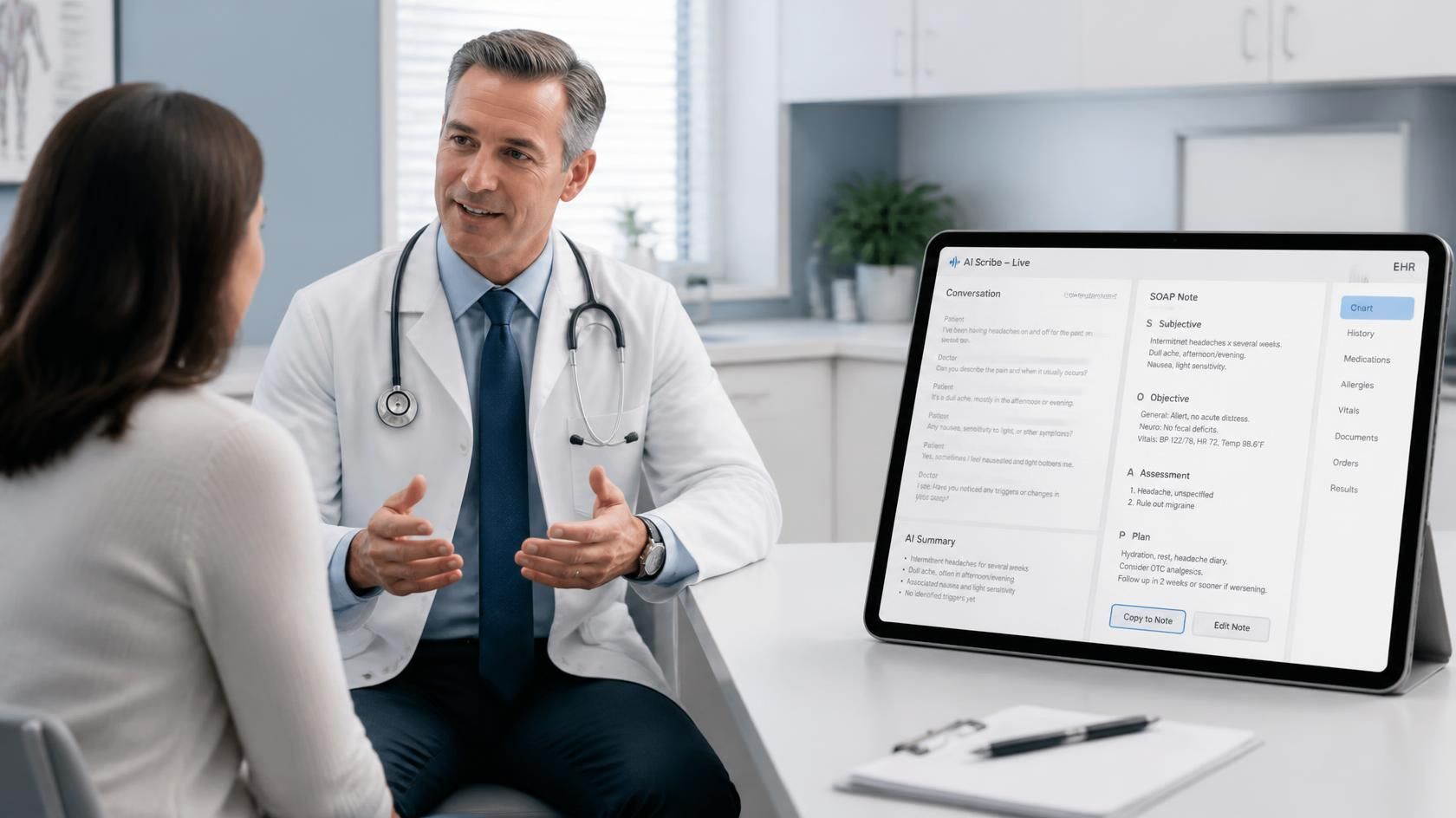
How NLP Powers AI Medical Scribes:
What Every Physician Needs to Know

Every physician knows the frustration. You finish a patient visit, then spend another ten to fifteen minutes capturing what was said. You type in fragments, abbreviate out of habit, and hope the EHR makes sense of it later. That gap between the conversation and the clinical note is exactly where NLP in medical scribing steps in and where the AI Medical Scribe finally becomes something clinically useful.
This article explains what natural language processing actually does inside an AI medical scribe, how it differs from simple speech recognition and older transcription methods, and why understanding this technology helps physicians make smarter decisions about their clinical documentation workflow.
What Is NLP in Medical Scribing?
Natural language processing (NLP) is the branch of artificial intelligence that enables computers to read, interpret, and generate human language in meaningful ways. In a medical scribing context, NLP is what allows an AI Medical Scribe to do far more than record words it allows the system to understand what was said, extract what is clinically relevant, and organize that information into structured documentation like SOAP notes, progress notes, or clinical summaries.
Unlike a simple audio recorder, an NLP engine reads intent. When a physician says, "She's been dealing with this for about three weeks, worse in the morning, some relief with ibuprofen," NLP identifies the symptom, duration, pattern, and treatment response and maps each element to its proper place in the clinical note.
NLP in medical scribing refers to AI technology that interprets spoken clinical conversations, extracts medically relevant information, and structures it into accurate EHR documentation. It enables AI Medical Scribes to understand physician language, medical terminology, and clinical context going well beyond simple transcription or voice-to-text conversion.
How NLP Powers
AI Medical Scribes
An AI Medical Scribe depends on NLP as its core reasoning engine. The process generally unfolds in several connected stages:
Stage 1: Acoustic Capture and Speech Recognition
The AI begins by capturing the spoken audio from a patient encounter either through a dedicated microphone, a smartphone app, or an integrated device. An automatic speech recognition (ASR) layer converts raw audio into text. This is the input stage. It is necessary but not sufficient on its own.
Stage 2: NLP Processing and Clinical Understanding
Once the conversation is transcribed as raw text, NLP takes over. The system analyzes sentence structure, vocabulary, and context. It distinguishes between the patient's reported symptoms and the physician's clinical assessment. It identifies named clinical entities diagnoses, medications, anatomical references, lab values and understands how they relate to each other within the encounter.
Stage 3: Medical Entity Recognition and Ontology Mapping
Specialized medical entity recognition allows the NLP engine to identify and classify clinical concepts: conditions, procedures, drug names, dosages, and anatomical terms. These entities are often mapped against standardized medical ontologies such as SNOMED CT, ICD-10, and RxNorm, which enables accurate downstream coding and EHR documentation alignment.
Stage 4: Structured Note Generation
The processed, entity-tagged data is then organized into a documentation format most commonly the SOAP framework (Subjective, Objective, Assessment, Plan). AI SOAP Notes generated through this process reflect the actual clinical encounter rather than a template-driven guess. The physician reviews and approves the draft before it is finalized in the EHR.
AI Medical Scribes use NLP to process spoken conversations in four connected stages: capturing audio, converting speech to text, extracting and classifying medical entities through clinical NLP models, and organizing the information into structured documentation like SOAP notes all within seconds of the patient encounter.
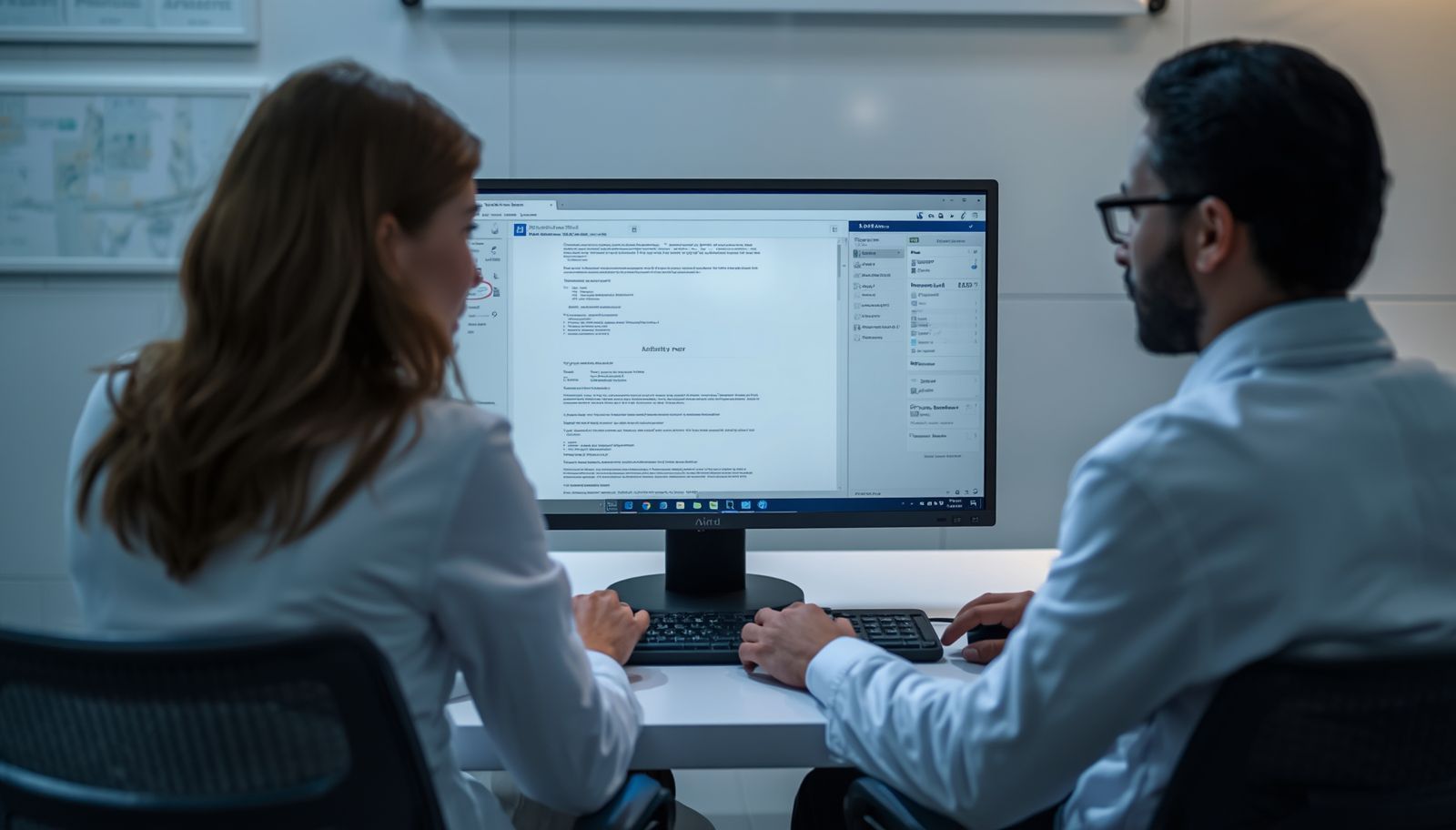
NLP vs. Speech Recognition:
Understanding the Difference
Physicians often use the terms speech recognition and NLP interchangeably. They are related but meaningfully different.
Speech recognition also called automatic speech recognition (ASR) converts spoken audio into written text. It answers the question: What was said?
NLP answers the question: What did it mean, and why does it matter clinically?
Consider this spoken statement: "Patient denies chest pain. PMH significant for HTN and Type 2 DM, currently on metformin." A speech recognition engine will transcribe those words accurately. An NLP engine will recognize that "PMH" is an abbreviation for past medical history, that "HTN" maps to hypertension, that "Type 2 DM" maps to diabetes mellitus type 2, and that metformin is a diabetes medication and it will place each element correctly within the documentation structure.
NLP is what transforms a transcript into a clinical note. Without it, speech recognition alone produces a raw dictation that still requires substantial manual editing. This distinction is important when evaluating
AI medical scribe software for your practice.
Speech recognition converts spoken words into text. NLP goes further it interprets meaning, identifies clinical entities, resolves medical abbreviations, and structures the output into accurate documentation. AI Medical Scribes require both technologies working together, but NLP is what separates an intelligent clinical documentation tool from a simple dictation app.
NLP vs. Traditional
Medical Transcription
Medical transcription services have long relied on trained human transcriptionists to convert physician-dictated audio into typed clinical notes. This approach is accurate and familiar, but it introduces lag time between dictation and the final document, and it depends on the quality of the original dictation.
NLP-powered AI medical documentation changes this dynamic. Instead of requiring a physician to dictate into a structured format, ambient NLP systems listen to the natural conversation, extract the clinically relevant elements in real time, and draft the note automatically often before the physician has left the exam room.
That said, transcription and AI are not mutually exclusive. Many
modern medical documentation services
use a hybrid model: AI handles the initial capture and structuring, and human clinical documentation specialists review for accuracy, compliance, and completeness before the note is signed. This human-in-the-loop approach preserves the judgment of experienced professionals while eliminating the documentation bottleneck.
Traditional medical transcription converts physician dictation into text through human transcriptionists, typically with a turnaround lag. NLP-powered AI medical scribes automate this process in real time during the encounter, without requiring structured dictation. Many practices now combine both using AI for speed and humans for review accuracy.

How AI Understands
Clinical Language and Medical Terminology
Medical language is one of the most complex linguistic environments in any professional field. It combines Latin-derived terminology, eponyms, brand and generic drug names, specialty-specific abbreviations, and highly variable speaker patterns across thousands of physician specialties and subspecialties.
Medical Language Ambiguity and Context
A term like *"positive" * means something completely different in a radiology note versus an oncology note versus a psychiatry intake. "Tender" in a musculoskeletal note differs from "tender" in a pediatric observation. Clinical NLP engines are trained to resolve this ambiguity using context-aware NLP analyzing surrounding language to assign the correct interpretation to each term.
Clinical Abbreviations
Physicians use abbreviations constantly and inconsistently. "PT" might mean physical therapy or patient. "MS" could refer to multiple sclerosis, morphine sulfate, or a mitral stenosis diagnosis depending on the specialty context. Healthcare-specific NLP models are trained on large volumes of clinical text to recognize these abbreviations by context and expand them correctly.
Specialty Terminology
A general-purpose language model will recognize common medical terms. But medical language models trained specifically for orthopedics, psychiatry, cardiology, or emergency medicine will capture specialty-specific phrases that general models routinely miss. This is why the depth of training data matters when evaluating AI scribe for doctors operating in subspecialties.
AI Confidence Scoring
Advanced NLP systems assign confidence scores to their outputs. Low-confidence segments phrases where the model is uncertain about the correct interpretation are flagged for physician review rather than silently inserted into the note. This transparency is an important safety mechanism in
AI clinical documentation systems that take HIPAA compliance and accuracy seriously.
AI Medical Scribes understand medical language through clinical NLP models trained to resolve abbreviations, specialty-specific terminology, and contextual ambiguity. They use medical entity recognition, ontology mapping, and confidence scoring to accurately interpret physician speech distinguishing between similar terms based on the clinical context around them.
How AI Creates
Structured Clinical Documentation
Structuring a clinical note is not just a formatting task it requires clinical reasoning applied to unstructured conversation. NLP systems accomplish this through several mechanisms:
Semantic segmentation identifies which parts of the conversation belong to the patient's subjective history, which are the physician's objective observations, which reflect the clinical assessment, and which outline the care plan.
Template adaptation allows the generated note to match the structure required by a specific specialty, visit type, or EHR format. An emergency department note looks different from a psychiatry progress note or a primary care follow-up, and modern clinical documentation software accounts for these differences automatically.
AI Progress Notes and SOAP Notes generated this way are not generic templates filled with placeholders. They reflect the specifics of that individual encounter the patient's own words, the physician's clinical findings, and the mutually agreed-upon plan.
All of this happens within the broader framework of the physician's EHR documentation workflow, with the draft note appearing in the chart for final review and approval.
NLP, Ambient AI, and
the Ambient Listening Layer
Ambient clinical documentation refers to AI systems that listen passively during patient encounters without requiring the physician to dictate, press buttons, or change how they communicate. NLP is the intelligence layer that makes ambient listening clinically useful.
When a physician conducts a visit naturally speaking with the patient, examining them, discussing the plan the ambient AI captures the conversation. NLP interprets it in real time, filtering out clinically irrelevant portions (greetings, small talk, scheduling discussions) and focusing on medically meaningful content.
Voice AI healthcare solutions that combine ambient listening with advanced NLP represent the current frontier of AI medical charting. Rather than interrupting the clinical encounter with documentation tasks, these systems allow physicians to remain fully present with their patients which is where they should be.
The distinction matters for practices evaluating tools: a
virtual medical scribe operates in real time alongside the physician, while a purely ambient AI system captures and processes the encounter passively. Both rely on NLP to produce accurate documentation; the difference is in how the audio is captured and whether a human reviews the output before it enters the chart.
Ambient AI captures patient-physician conversations passively without requiring dictation. NLP is the intelligence layer that interprets what was captured filtering clinical content, extracting relevant information, and drafting structured notes. Together, they form the foundation of modern ambient clinical documentation.
NLP and
EHR Documentation Integration
Even the most accurate NLP output has limited value if it cannot move efficiently into the physician's existing electronic health records system. Integration is where many AI documentation tools succeed or fall short in practice.
Effective AI medical documentation platforms connect directly with major EHR systems including Epic, Cerner, athenahealth, eClinicalWorks, and others through certified APIs. This allows the NLP-generated note to populate the correct fields within the existing chart, rather than creating a separate document that the physician must manually copy over.
Well-integrated clinical documentation software also supports downstream workflows: the structured clinical content can inform medical coding recommendations, flag documentation gaps relevant to E&M coding levels, and support clinical decision support tools that rely on coded data.
Practices considering
AI medical scribe software should evaluate EHR integration depth carefully the quality of the NLP engine matters, but seamless workflow integration determines whether physicians actually use it.

Benefits of
NLP-Powered AI Scribes for Physicians
The documentation burden on U.S. physicians is well-documented. Studies consistently show that physicians spend as much as 37–49% of their workday on administrative and EHR-related tasks — time that could be spent with patients.
NLP-powered AI Medical Scribes directly address this:
- Reduced documentation time.
Physicians who use AI scribe tools report meaningful reductions in after-visit charting time, with some studies citing reductions of up to 60% in documentation hours.
- Less cognitive load.
The mental effort of simultaneously managing a patient conversation and planning a documentation narrative is significant. Ambient NLP removes that split-attention burden.
- More accurate notes. NLP systems don't tire, rush, or forget. When trained appropriately, they capture clinical details that busy physicians under time pressure might abbreviate or omit.
- Reduced provider burnout. Documentation-related burnout is a widely reported contributor to physician dissatisfaction and early departure from practice. Reducing the documentation burden has measurable effects on physician wellbeing.
- Better patient interaction. When physicians are not mentally composing notes during a visit, they maintain better eye contact, ask better follow-up questions, and communicate more effectively.
Benefits for Healthcare
Organizations and Medical Groups
For medical groups, private practices, hospitals, and healthcare administrators, the organizational benefits of NLP-driven AI clinical documentation extend beyond individual physician efficiency:
- Throughput and capacity. Faster documentation allows practices to manage higher patient volumes without extending physician hours.
- Coding accuracy. NLP systems that map clinical content to structured codes improve the accuracy of medical coding and reduce claim denial rates.
- Clinical documentation improvement (CDI). Well-structured notes generated by NLP tools support CDI initiatives by ensuring that clinical specificity is captured at the point of care rather than amended retroactively.
- Compliance. Consistent, timestamped, complete documentation supports HIPAA compliance and reduces medicolegal exposure from poorly documented encounters.
- Scalable documentation quality. Unlike staffing-dependent solutions, NLP-based documentation quality scales consistently across a growing practice.
Limitations and
Clinical Considerations
NLP in medical scribing has advanced considerably, but clinical leaders should understand its real limitations:
- Hallucination risk.
Large language models can occasionally generate clinically plausible but factually incorrect content a phenomenon called hallucination. In a documentation context, this means a note might include a medication or finding that was never mentioned. This is why human-in-the-loop review where a trained clinical reviewer or the physician themselves approves every note before it is finalized remains an essential safeguard.
- Specialty gaps.
NLP models trained primarily on primary care or general medicine text may underperform in highly specialized contexts such as interventional radiology, pediatric subspecialties, or complex surgical documentation. Evaluating specialty-specific performance is important before deployment.
- Acoustic challenges. Background noise, soft-spoken patients, strong accents, and simultaneous speakers can degrade the speech-to-text input that NLP depends on. The accuracy of the NLP output is only as good as the audio it receives.
- HIPAA obligations. Clinical conversations include protected health information (PHI). Any
AI medical scribe software used in a U.S. practice must operate under a signed Business Associate Agreement (BAA) and handle audio and text data in compliance with HIPAA regulations.
- Physician review is non-negotiable. AI-generated clinical notes should always be reviewed and signed by the treating physician before entering the permanent medical record. NLP is a productivity tool, not a clinical authority.
The Future of NLP
in Healthcare Documentation
The trajectory of NLP in clinical settings points toward greater accuracy, deeper clinical reasoning, and broader interoperability.
Medical-specific large language models trained on clinical text rather than general internet data are producing meaningfully better results in healthcare contexts. As training datasets grow to include more specialty-specific clinical encounters, the accuracy of NLP-generated documentation will continue to improve.
Multimodal AI is beginning to combine NLP with structured data from wearables, imaging reports, and lab values to produce documentation that reflects the full clinical picture rather than only the spoken encounter.
Clinical decision support integration will allow NLP systems to not only document what was said but flag potential drug interactions, missing preventive care elements, or diagnostic considerations based on the documented encounter content extending NLP from documentation into active clinical reasoning support.
For physician documentation in the U.S., the next several years will bring increasingly intelligent, seamlessly integrated tools but the fundamental role of the physician in reviewing, approving, and owning the clinical record will not change.
Best Practices for
Physicians Using AI Medical Scribes
Getting the most from NLP-powered clinical documentation tools requires some intentional habits:
- Speak clearly and completely. NLP systems perform best when clinical language is used precisely. Avoid heavily fragmented sentences when discussing the assessment and plan.
- Always review before signing. Never finalize an AI-generated note without reading it. Flag any content that was not discussed or is clinically inaccurate.
- Use the feedback loop. Most AI scribe software includes correction mechanisms. Marking errors helps the system improve its performance for your specialty and speaking patterns over time.
- Clarify during the visit. If you want a specific clinical decision documented clearly, state it explicitly during the encounter rather than relying on the AI to infer it from context.
- Confirm your BAA. Verify that your medical documentation software vendor has executed a HIPAA-compliant Business Associate Agreement before any patient audio is processed.
- Train your team. Front desk staff, nurses, and medical assistants should understand how the AI scribe integrates into the visit workflow to avoid confusion during patient encounters.

Conclusion
NLP in medical scribing is not a feature it is the foundation of everything a functional AI Medical Scribe does. Without it, you have a voice recorder. With it, you have a clinical documentation system that understands physician language, interprets medical terminology in context, and produces structured notes that reflect the real encounter.
For U.S. physicians facing mounting documentation demands, NLP-powered tools represent a meaningful shift in how clinical time is spent. The technology continues to improve, and the practices that understand how it works will be better positioned to evaluate it honestly choosing solutions that are accurate, compliant, and genuinely aligned with how they practice medicine.
If your practice is evaluating
AI medical documentation options,
Chase Clinical Documentation offers physician-focused solutions that combine AI efficiency with human clinical oversight because accurate documentation is never just a technology question.
FAQ
What is NLP in medical scribing?
NLP (natural language processing) in medical scribing is the AI technology that enables a system to understand, interpret, and structure clinical conversations into organized medical documentation. It goes beyond transcription by extracting clinical meaning, identifying medical entities, and generating structured notes like SOAP notes or progress notes automatically.
How do AI Medical Scribes understand what doctors say?
AI Medical Scribes use specialized clinical NLP models trained on large volumes of medical text and conversation data. These models recognize medical terminology, specialty-specific abbreviations, and clinical context allowing them to correctly interpret spoken physician language even when it includes shorthand, overlapping speech, or complex clinical reasoning.
How accurate is NLP in healthcare documentation?
Accuracy varies by system, specialty, and acoustic environment. Leading platforms report high rates of clinical accuracy, but no NLP system is error-free. Physician review before note finalization is essential. Confidence scoring and human-in-the-loop review mechanisms are important features to look for in any AI medical scribe solution.
Can NLP replace medical transcription entirely?
NLP-powered AI can automate much of what traditional medical transcription services handled. However, many practices benefit from a hybrid approach where AI generates the initial draft and trained human reviewers verify accuracy and completeness. This combination delivers both speed and the clinical judgment that AI alone cannot yet fully replicate.
How does AI understand medical abbreviations and terminology?
Clinical NLP models are trained on medical text that includes specialty-specific abbreviations, drug names, diagnoses, and clinical language patterns. Context-aware models resolve ambiguous abbreviations by analyzing surrounding language distinguishing, for example, between "MS" as multiple sclerosis versus morphine sulfate based on the clinical context.
How do AI Medical Scribes create SOAP Notes?
NLP engines analyze the clinical conversation and apply semantic segmentation to identify subjective information (patient-reported symptoms), objective findings (physical exam, vital signs), clinical assessment (diagnoses and impressions), and the care plan. These segments populate a SOAP-formatted note, which the physician reviews before it is finalized in the EHR.
Does NLP improve physician documentation quality?
Yes, in several ways. NLP-powered AI scribes capture clinical details in real time without the omissions that occur when physicians document from memory after a visit. They also produce consistently structured notes, which improves documentation completeness, coding accuracy, and downstream clinical communication.
Recent Posts