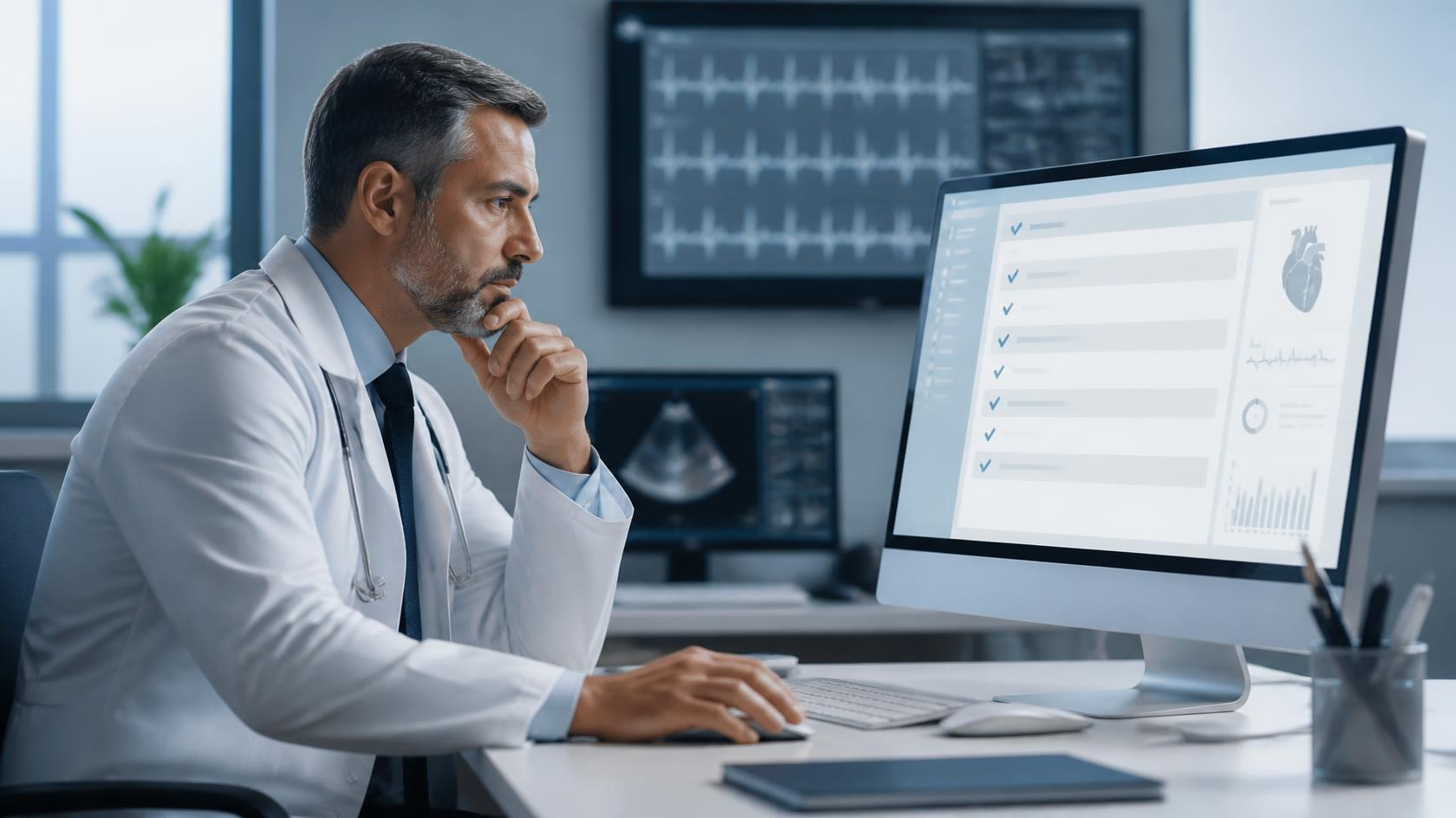
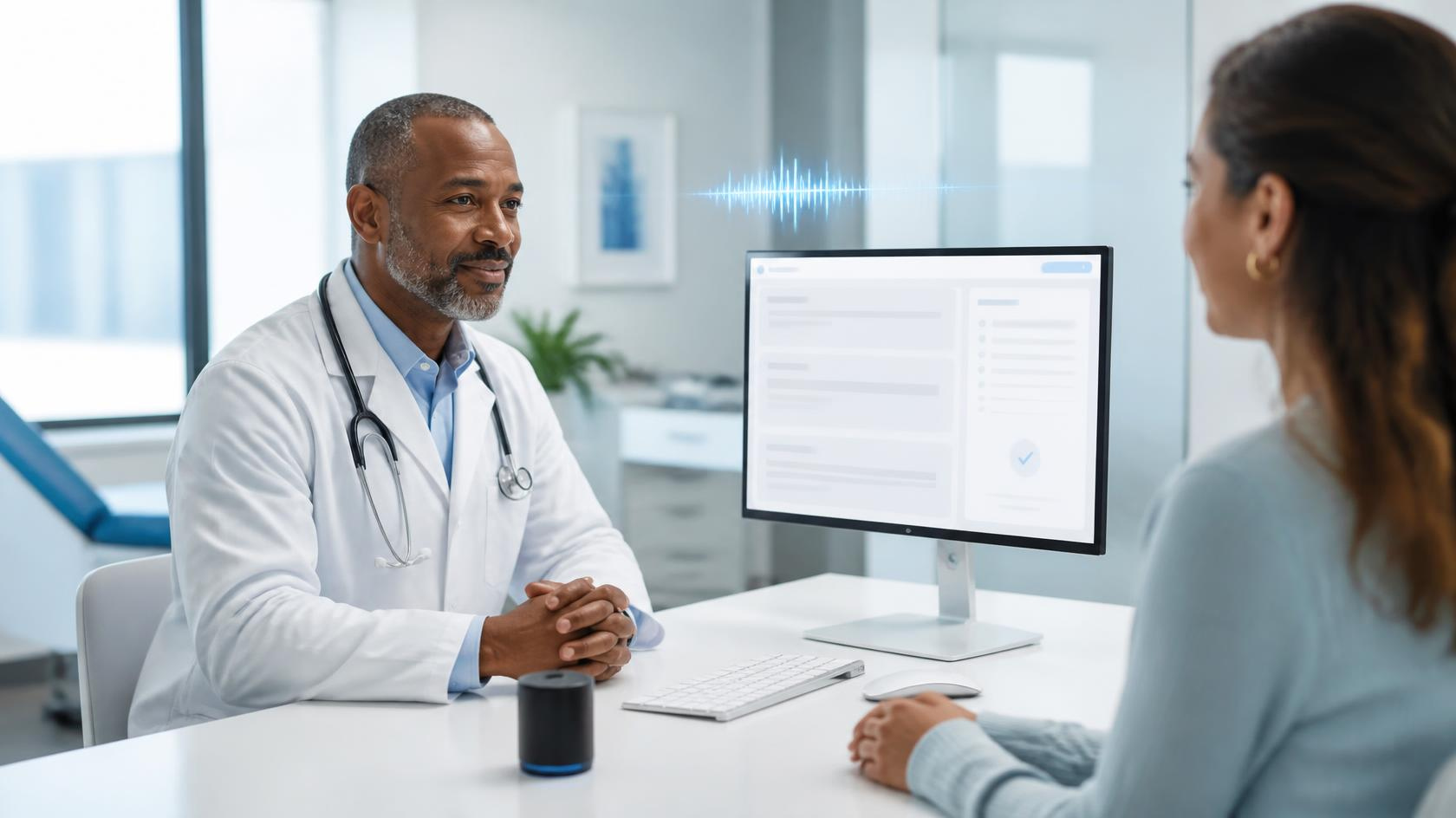
How to Train Physicians
to Use an AI Medical Scribe Effectively
Why Physician Training Matters When Implementing an AI Medical Scribe
Successful AI medical scribe adoption depends far more on physician behavior than on the technology itself. When physicians understand what the tool does, how to communicate during patient encounters, and how to review AI-generated notes, documentation quality improves and adoption sticks. Without structured physician training, even the best AI scribe software underperforms.
The technology captures and structures clinical language in real time but the physician remains the clinical author. That distinction shapes every aspect of training.
What Should Physicians Learn Before Using an AI Medical Scribe?
Before a physician uses an AI medical scribe in a live patient encounter, they need a clear picture of the tool's role and its limits. Specifically, physicians should understand:
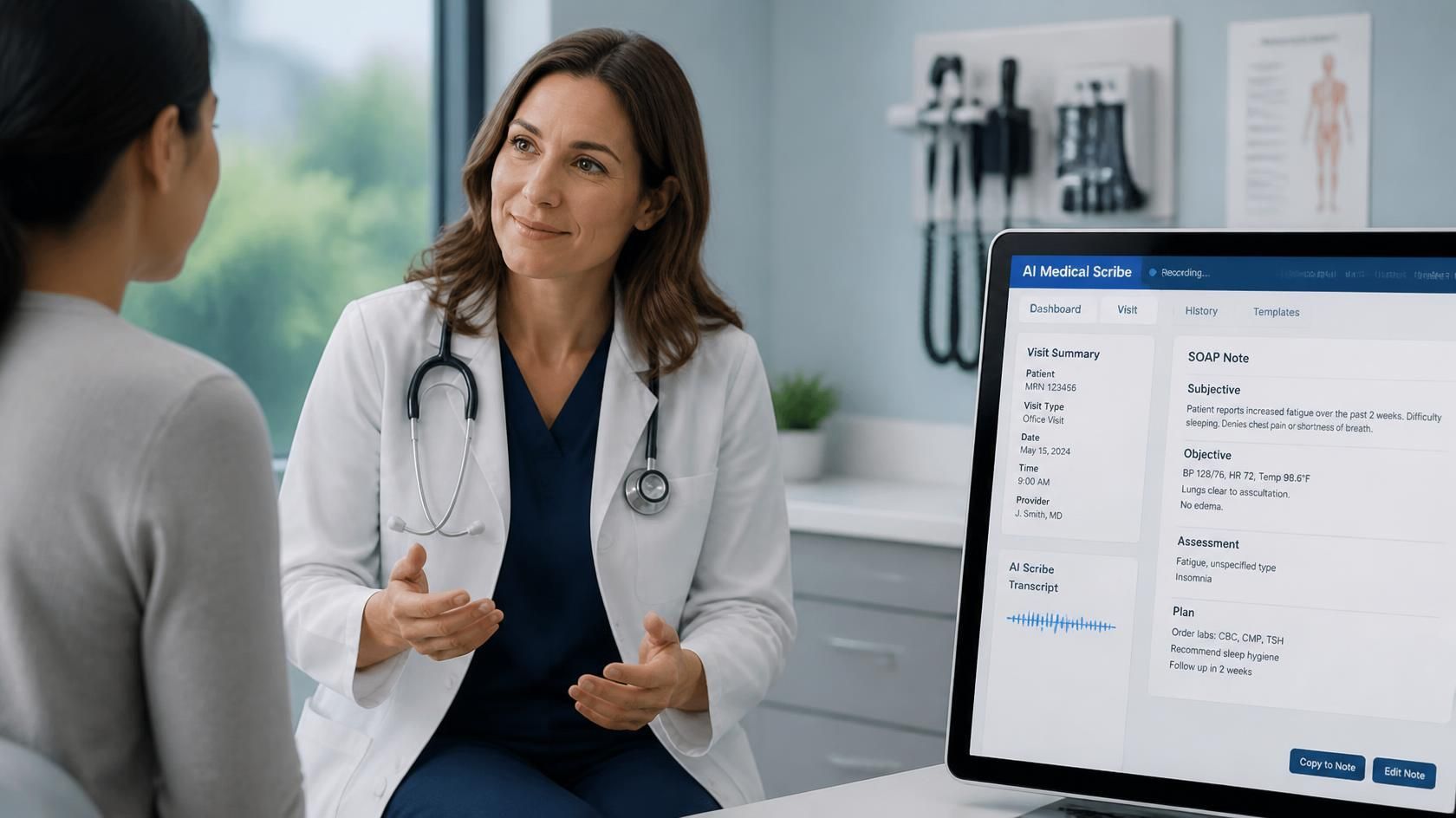
- What the AI medical scribe does — It listens to the encounter, interprets clinical language, and generates a draft note, typically structured as a SOAP note or progress note within the EHR.
- What it does not do — It does not make clinical decisions, guarantee accuracy, or eliminate the physician's documentation responsibility.
- How the workflow operates — When to activate and end a session, how audio is processed, and how the draft appears in the EHR.
- Why physician review is non-negotiable — AI-generated clinical notes can miss, misinterpret, or misplace information. The physician must review and approve every note before finalization.
- What information should be communicated clearly — Critical findings, medication changes, and diagnostic reasoning should be stated clearly during the encounter, not assumed to be captured from context.
This foundation prevents the most common and costly mistakes before they happen.
6 Steps to Train Physicians
to Use an AI Medical Scribe
Step 1: Start With Workflow Orientation
Walk the physician through the technical workflow before any patient is involved. Show how to activate the AI scribe, confirm the session is recording, and locate the draft note in the EHR after the encounter ends. Clarity here prevents hesitation during real clinical encounters.
Step 2: Demonstrate a Complete Patient Encounter
Have a trained team member demonstrate a patient encounter from start to finish with the AI medical scribe running. The physician observes how clinical language translates into a draft note, where the output captures information accurately, and where it may need correction. A live demonstration is more effective than written instructions.
Step 3: Use Supervised or Simulated Encounters
Before going fully independent, have the physician complete two to four supervised or mock encounters. This allows them to test how they naturally speak during exams, identify any habits that confuse the AI, and build confidence before adopting the workflow with actual patients.
Step 4: Teach Effective Physician-AI Communication Habits
Physicians do not need to change their natural patient communication. What they do need to learn is how to briefly verbalize key clinical details that might otherwise go uncaptured. For example, stating "assessment: Type 2 diabetes, well-controlled" clearly tends to produce better output than relying on context alone. This is a skill physicians develop through repetition, not a scripted approach.
Step 5: Train Physicians to Review and Correct Notes
Note review is where physician training has the most direct impact on documentation quality. Physicians should check:
- Patient demographics and reason for visit
- Chief complaint and symptom history
- Relevant examination findings
- Assessment and differential
- Treatment plan and medication changes
- Orders, referrals, and follow-up instructions
Physicians should also flag any recurring errors missed terms, misplaced findings, incorrect laterality—so those patterns can be addressed through workflow adjustments or feedback to the vendor.
Step 6: Provide Ongoing Feedback and Optimization
Initial training is a starting point, not an endpoint. Schedule brief follow-up check-ins at one week and thirty days after go-live. Review actual notes with the physician to identify patterns, answer questions, and refine habits. Practices using
AI medical scribe software like Ezyscribe benefit from this feedback loop because it accelerates the point at which the physician is truly confident and consistent.

How Physicians Should
Review AI-Generated Clinical Notes
Physician review of AI-generated documentation should be deliberate, not a cursory scan. The physician is the clinical author of record. That responsibility does not transfer to the AI system.
A structured review covers: patient information, chief complaint, history of present illness, relevant past medical and social history, physical examination findings, assessment, plan, medications, and follow-up instructions. Missing items are as important as incorrect ones. A plan section that omits a medication change or a follow-up timeframe creates a real documentation gap.
Physicians who treat note review as a final edit rather than a passive approval catch errors before they enter the permanent record. Over time, review becomes faster as the physician learns how the AI renders their specific clinical language.

Common Physician
Training Mistakes to Avoid
A few patterns consistently slow adoption and reduce documentation quality:
- Treating the AI scribe as fully autonomous. The tool generates a draft. The physician finalizes it.
- Skipping note review under time pressure. Review time decreases with practice but should never be eliminated.
- Expecting perfect output immediately. AI medical scribes improve as physicians learn to communicate more precisely. Early imperfection is normal.
- Changing natural patient communication. Physicians should not sound like they are dictating. Conversation is the signal.
- Ignoring recurring errors. Patterns in output errors usually reflect fixable communication habits or configuration issues.
- Stopping training after the first week. Physicians benefit from structured coaching at the thirty and ninety day marks.
- Skipping specialty-specific workflow adjustments. A cardiologist and a psychiatrist interact with the tool differently. Train accordingly.
How to Measure Successful
AI Medical Scribe Adoption
Tracking adoption provides the data practices need to optimize training. Relevant indicators include:
- Physician adoption rate — What percentage of physicians are using the tool consistently?
- Note review time — How long does the physician spend editing before sign-off?
- Editing frequency — How often are major corrections required versus minor adjustments?
- Documentation turnaround time — Are notes completed faster than before implementation?
- Provider satisfaction — Are physicians finding the workflow sustainable?
- Documentation completeness — Are notes meeting coding and compliance requirements?
These metrics inform where additional coaching is needed and help practices demonstrate return on investment from their
AI clinical documentation
platform.

Final Takeaway
Effective physician training for an AI medical scribe is not a one-time orientation. It is a progression: orientation, demonstration, supervised practice, communication coaching, systematic note review, and ongoing feedback. Practices that invest in this cycle see better documentation quality, faster physician confidence, and more sustainable adoption than those that treat implementation as a technology deployment alone.
The physician remains at the center. The AI medical scribe handles the documentation workload. That combination—technology, trained physician behavior, and consistent clinical oversight—is what makes AI-assisted clinical documentation work in real practice environments.
For practices evaluating where this fits alongside virtual medical scribe services, medical transcription, or medical dictation, the training framework remains consistent: build physician skill first, then measure results.
FAQ
How do you train physicians to use an AI medical scribe?
Physicians should begin with workflow orientation, followed by a demonstrated patient encounter and supervised practice. Training should then cover effective physician-AI communication, systematic review of AI-generated notes, error correction, and ongoing feedback. This approach helps physicians build confidence while maintaining clinical oversight of the final documentation.
What should physicians review in an AI-generated clinical note?
Physicians should review patient information, the chief complaint, clinical history, examination findings, assessment, treatment plan, medications, orders, referrals, and follow-up instructions. They should correct missing, inaccurate, or misplaced information before approving the note. Physician review remains an essential part of responsible AI-assisted clinical documentation.
How long does it take physicians to learn an AI medical scribe?
The learning period varies by physician, specialty, workflow, and software. A structured approach using demonstrations, supervised encounters, and follow-up coaching can accelerate adoption. Initial training should not be treated as the end of the process because physicians often improve their workflow through continued use and feedback.
What are common mistakes physicians make when using AI medical scribes?
Common mistakes include treating the AI scribe as fully autonomous, skipping note review, expecting perfect results immediately, ignoring recurring documentation errors, and failing to adapt the workflow to the physician's specialty. Ongoing coaching can help physicians identify and correct these issues.
Do physicians need to review AI-generated medical notes?
Yes. AI medical scribes generate draft clinical documentation, but physicians should review the content for accuracy, completeness, and clinical appropriateness before finalizing the record. Important areas include the assessment, treatment plan, medications, clinical findings, and follow-up instructions.
Does AI medical scribe training differ by specialty?
Yes. Training should account for specialty-specific documentation requirements, encounter types, terminology, and workflows. A primary care physician, cardiologist, psychiatrist, or other specialist may use different documentation patterns. Specialty-specific examples and practice encounters can make AI scribe training more effective.
How can medical practices improve physician adoption of AI scribes?
Practices can improve adoption by providing structured onboarding, practical demonstrations, supervised practice, clear documentation-review procedures, specialty-specific guidance, and ongoing feedback. Tracking metrics such as adoption, note review time, editing frequency, and documentation turnaround can help identify where additional training is needed.
How should a medical practice choose between live and post-visit scribing?
Practices should evaluate factors such as physician preference, encounter type, specialty, documentation complexity, EHR workflow, turnaround expectations, and scheduling flexibility. Comparing these factors can help determine which scribing model fits the practice best.
Recent Posts