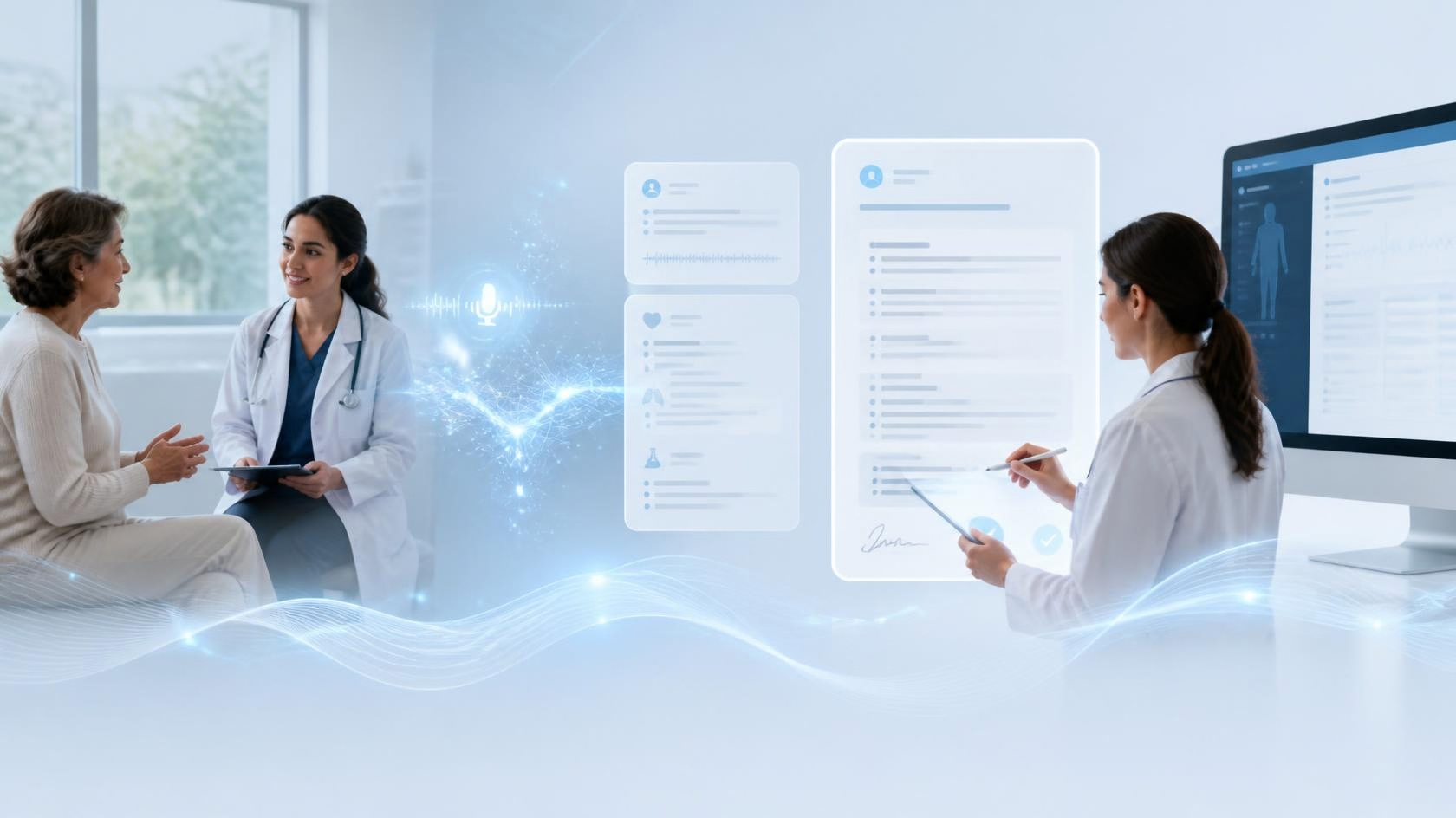
Virtual Medical Scribe for Primary Care: Managing High-Volume Documentation

The Documentation Problem in Primary Care
By midmorning, a primary care physician is already four patients behind schedule. The waiting room has not changed, but the chart from the second appointment is still open, the referral from the third needs a note, and the medication review from the fourth requires documentation before the afternoon refill queue begins.
This is not a time-management failure. It is a structural reality of primary care documentation. Physicians managing 20 to 30 patient encounters per day across routine visits, chronic disease follow-ups, preventive screenings, and medication management face documentation demands that compound with every appointment. Each encounter generates clinical notes, EHR entries, SOAP notes, referral documentation, and patient history updates. Individually, none of these tasks is unreasonable. Together, they create a documentation workload that competes directly with patient care time.
Can a Virtual Medical Scribe Help Primary Care Physicians Manage High-Volume Documentation?
Yes, in meaningful ways within clear boundaries. A
virtual medical scribe for primary care
can support documentation throughput by drafting clinical notes, organizing encounter information, and helping reduce after-hours charting time. The physician remains responsible for reviewing, editing, and approving every note. Scribing addresses documentation volume, not clinical decision-making.

Where Documentation
Volume Builds Up in Primary Care
Primary care encounters are not uniform. A morning schedule may include a 15-minute routine wellness visit, a 30-minute chronic disease management appointment for a patient with diabetes and hypertension, a medication reconciliation discussion, a new-patient intake with a detailed history, and two urgent-care walk-ins.
Each visit generates its own documentation category:
- Routine office visits require SOAP notes, vital sign documentation, and assessment summaries.
- Chronic disease follow-ups involve updating problem lists, recording lab review discussions, and adjusting care plans.
- Preventive care visits include health maintenance documentation, screening results, and patient counseling notes.
- Medication management appointments require updated medication lists, discussion documentation, and prescription records.
- Referral visits generate referral letters, clinical summaries, and coordination notes.
- Patient history updates must be captured accurately and entered into the EHR.
The challenge is not any single document. It is the cumulative effect across a high-volume schedule, where documentation that should take minutes per encounter instead spills into lunch breaks, evenings, and weekends.
A Typical High-Volume Primary
Care Workflow With Scribe Support
A virtual medical scribe typically operates in a structured workflow around the patient encounter:
Patient Encounter → Information Capture → Draft Clinical Note → Physician Review → EHR Completion
During the encounter, the scribe listens in real time (or reviews a recording in asynchronous models) and documents the relevant clinical information patient-reported symptoms, physician observations, assessment details, and plan elements. The scribe organizes this into a structured draft note, commonly in SOAP format.
The physician then reviews the draft, makes any necessary clinical edits, and approves the note before it enters the permanent medical record. At no point does the scribe make clinical decisions or independently complete the patient record.
This workflow does not eliminate
physician documentation involvement. It reorganizes it. Instead of rebuilding the encounter from memory after the appointment, the physician reviews and refines a draft that is already structured. For high-volume schedules, that shift can meaningfully reduce the time required per note.

Where a Virtual Medical Scribe
Creates the Most Value
| Workflow Need | How Virtual Scribing Can Help |
|---|---|
| High encounter volume | Supports documentation throughput across multiple daily visits |
| SOAP note creation | Drafts structured notes for physician review |
| Documentation backlog | Helps move notes toward completion in a timely manner |
| Physician review | Leaves final approval and edits with the physician |
| Repetitive documentation | Reduces manual re-entry of recurring encounter elements |
← Scroll to see full table
The practical value depends heavily on workflow design, physician adoption, technology integration, and quality oversight. Organizations that invest in clear scribing protocols and consistent physician review processes tend to get more consistent results than those
implementing scribing without structured workflows.
Live, Virtual, or AI-Assisted: What Changes?
Primary care practices today can choose from several scribing models:
Human virtual medical scribes work remotely, attending patient encounters via a secure audio or video connection and drafting notes in real time or near-real time. They bring clinical terminology knowledge and can adapt to a physician's documentation preferences.
AI-assisted medical scribing uses automated speech recognition and natural language processing to generate draft notes from encounter recordings. Some platforms combine AI drafting with human review layers often called human-in-the-loop workflows where a trained reviewer refines AI-generated content before physician sign-off.
For high-volume primary care practices, the most practical question is not which technology is more advanced, but which model fits the practice's pace, EHR environment, privacy requirements, and documentation expectations. Some practices use AI documentation tools for routine visit types while relying on human scribes for complex encounters. These decisions are best made with realistic assessments of each model's current capabilities.
The Physician Still
Owns the Clinical Record
Regardless of the scribing model, the physician remains the responsible party for the accuracy and completeness of the medical record. A virtual medical scribe supports documentation. The physician reviews, edits where needed, and approves every note before it becomes part of the official record.
This is not just a best practice it is the appropriate structure for physician oversight of clinical documentation. Scribe-drafted notes that enter the record without physician review are not a supported documentation workflow. The value of a scribe is freeing up physician attention during and after the encounter, not removing physician judgment from the documentation process.
Organizations evaluating virtual scribing should also review vendor security controls, access protocols, data handling practices, and HIPAA-related contractual safeguards as applicable to their specific environment.

When Should a Primary Care Practice Consider a Virtual Medical Scribe?
Not every practice has the same documentation problem. These are practical indicators that a virtual scribing arrangement may be worth evaluating:
- Increasing documentation backlog Physicians are consistently completing notes 24 to 48 hours after the encounter.
- High daily encounter volume The practice regularly schedules 20 or more patient visits per physician per day.
- After-hours charting time Physicians are spending evenings or weekends on documentation that accumulated during the clinical day.
- Administrative workload competing with patient time Documentation requirements are visibly affecting the quality or length of patient interactions.
- Need for a scalable documentation process The practice is growing and needs documentation support that can scale with encounter volume without proportional increases in physician documentation time.
A structured evaluation should include current documentation volume, EHR compatibility, staffing considerations, and workflow readiness before implementation.
Documentation Should
Support Care, Not Compete With It
The core purpose of a virtual medical scribe for primary care is straightforward: help reduce the documentation burden so the physician can focus on the patient in the room. That does not mean eliminating physician responsibility. It means structuring the work so that documentation is organized, timely, and reviewable rather than an accumulating liability at the end of each clinical day.
For primary care practices managing high patient volume, scribing is not a technology decision as much as a workflow decision one that should be made with a clear understanding of what scribing can support and what the physician must still own.
Chase Clinical Documentation and its
Ezyscribe platform offer virtual medical scribe and
AI medical scribe services designed for clinical documentation workflows in primary care and other outpatient settings. Practices evaluating documentation support options can review available service models and discuss implementation with the team directly.
FAQ
What is a virtual medical scribe for primary care?
A virtual medical scribe for primary care is a trained documentation specialist who works remotely to support clinical note creation during or after patient encounters. The scribe drafts structured notes typically in SOAP format which the physician then reviews, edits as needed, and approves before they become part of the medical record.
How does a virtual medical scribe help primary care physicians with high encounter volume?
By handling the initial drafting of clinical notes across multiple encounters, a virtual scribe reduces the time a physician spends reconstructing each visit after the fact. This can help reduce after-hours documentation time and support more consistent note completion, particularly when a physician is managing 20 or more patient visits per day.
Does a virtual medical scribe write SOAP notes?
Yes. Drafting SOAP notes Subjective, Objective, Assessment, and Plan is one of the primary documentation tasks a virtual medical scribe supports. The physician reviews and finalizes the note before it enters the EHR.
What is the difference between a virtual medical scribe and an AI medical scribe?
A virtual medical scribe is a human working remotely who drafts clinical notes in real time or from encounter recordings. An AI medical scribe uses automated speech recognition and natural language processing to generate draft notes algorithmically. Some workflows combine both AI generates the initial draft and a human reviewer refines it before physician sign-off. Each model has different strengths depending on encounter complexity, practice volume, and EHR environment.
Does the physician still need to review notes if a virtual scribe creates them?
Yes, always. The physician is responsible for the accuracy and completeness of every entry in the medical record. A virtual scribe's draft is a documentation support tool, not a final record. Physician review and approval are required before a scribe-drafted note is complete.
Recent Posts