Medical Transcription vs AI Medical Transcription:
Which Is Best for U.S. Healthcare Practices?

Healthcare providers across the United States face growing documentation demands. Physicians are expected to deliver quality patient care while keeping electronic health records (EHRs) complete, accurate, and compliant. At the same time, staffing shortages, physician burnout, and increasing administrative workloads make clinical documentation more challenging than ever.
Artificial intelligence has transformed healthcare documentation. AI Medical Transcription solutions can convert speech into text within seconds, while AI Medical Scribes help automate clinical note creation. Yet speed alone does not guarantee accuracy. Medical terminology, specialty-specific language, and regulatory requirements still require careful human oversight.
So, which option delivers the best results AI Medical Transcription or Human Medical Transcription?
For most U.S. healthcare organizations, the answer lies in understanding the strengths and limitations of each approach. This guide compares both solutions and explains why many hospitals, physician groups, and specialty practices are adopting a hybrid documentation model to improve efficiency without compromising documentation quality.
What Is AI Medical Transcription?
AI Medical Transcription uses speech recognition and artificial intelligence to convert physician dictation into written medical documentation automatically.
Unlike traditional transcription, AI systems analyze spoken language, identify medical terminology, and generate clinical notes in real time or shortly after patient encounters.
Many AI platforms also function as AI Medical Scribes by listening during patient visits and drafting documentation directly into Electronic Health Records (EHRs).
Healthcare organizations use AI Medical Transcription to:
- Reduce documentation turnaround time
- Improve physician productivity
- Support faster clinical workflows
- Minimize repetitive administrative work
- Generate structured clinical notes
While AI technology continues to improve, documentation quality depends heavily on audio clarity, specialty-specific vocabulary, and the complexity of the patient encounter.
What Is Human Medical Transcription?
Human Medical Transcription involves trained documentation specialists who convert physician dictation into accurate, structured clinical records.
Unlike AI alone, professional transcriptionists understand medical terminology, clinical context, abbreviations, specialty-specific language, and physician preferences. They review recordings carefully, correct inconsistencies, and ensure documentation aligns with healthcare standards.
Experienced transcription professionals also support:
- Specialty documentation
- Documentation quality assurance
- HIPAA-compliant workflows
- Medical record accuracy
- Consistent formatting
- Faster physician review
For hospitals, specialty clinics, and multi-provider practices, Human Medical Transcription continues to play a vital role in maintaining reliable patient documentation.
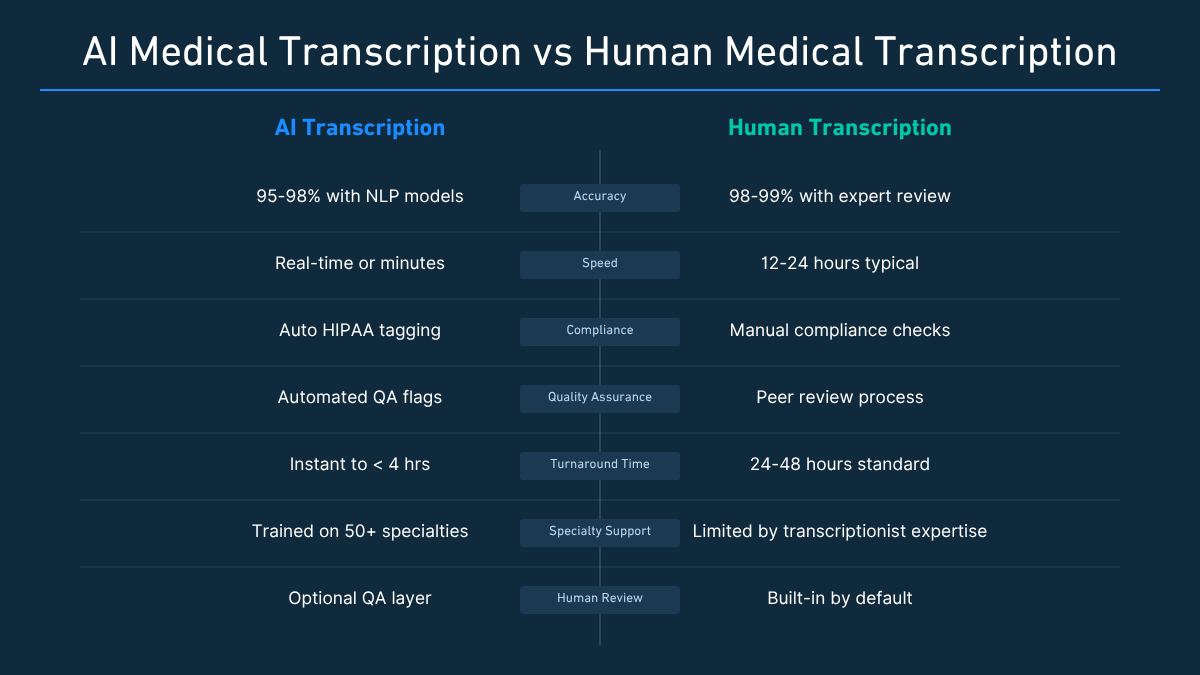
AI Medical Transcription vs
Human Medical Transcription
Choosing between AI Medical Transcription and Human Medical Transcription depends on your practice's documentation needs, patient volume, specialty, and compliance requirements. While AI offers speed and automation, human expertise provides greater accuracy and quality assurance for complex clinical documentation.
AI Medical Transcription
- Accuracy: High for clear and structured dictation, but performance may vary with complex medical terminology or poor audio quality.
- Speed: Generates documentation almost instantly, helping providers reduce turnaround time.
- Medical Terminology: Recognizes many common medical terms but may occasionally misinterpret specialty-specific language or uncommon terminology.
- Specialty Documentation: Suitable for routine documentation but may require review for complex specialties such as cardiology, oncology, orthopedics, or behavioral health.
- Human Review: Often optional, depending on the platform and workflow.
- HIPAA Compliance: Varies by vendor. Healthcare organizations should ensure the solution meets HIPAA security and privacy requirements.
- Quality Assurance: Limited to the platform's built-in capabilities unless paired with human editing.
- Complex Cases: May struggle with multiple speakers, nuanced conversations, abbreviations, or detailed clinical narratives.
- Cost: Lower initial documentation costs due to automation.
- Best For: High-volume practices seeking faster documentation for routine patient encounters.
Human Medical Transcription
- Accuracy: Delivers exceptional accuracy through professional review and contextual understanding.
- Speed: Fast turnaround with an added quality review process to ensure reliable documentation.
- Medical Terminology: Experienced transcription specialists understand complex medical vocabulary, abbreviations, and specialty-specific terminology.
- Specialty Documentation: Ideal for complex documentation across specialties, including emergency medicine, radiology, cardiology, surgery, oncology, and behavioral health.
- Human Review: Every document is reviewed and refined by trained professionals before completion.
- HIPAA Compliance: Documentation workflows follow strict security, privacy, and quality control processes to support HIPAA compliance.
- Quality Assurance: Multiple quality checks help reduce documentation errors and improve record consistency.
- Complex Cases: Excels at interpreting nuanced clinical conversations, physician preferences, and challenging dictation.
- Cost: May involve a higher upfront investment, but improved documentation accuracy can reduce costly corrections, claim denials, and compliance issues.
- Best For: Hospitals, multi-specialty practices, physician groups, and healthcare organizations that require highly accurate clinical documentation.
Key Takeaway
If your primary goal is speed and workflow automation, AI Medical Transcription is a valuable solution. If your priority is documentation accuracy, specialty expertise, and regulatory compliance, Human Medical Transcription remains the preferred choice. For many U.S. healthcare organizations, combining AI technology with expert human review offers the most effective balance of efficiency, accuracy, and high-quality patient documentation.
Advantages of
AI Medical Transcription
Clinical notes can be generated within minutes, reducing documentation delays.
Improved Physician Productivity
Less time spent typing allows providers to focus more on patient care.
AI handles large documentation volumes without significant staffing increases.
AI integrates with many EHR platforms and helps automate repetitive documentation tasks.
Limitations of AI Medical Transcription
Despite rapid advancements, AI still has important limitations.
AI may struggle with:
- Multiple speakers
- Strong accents
- Background noise
- Rare medical terminology
- Specialty-specific procedures
- Contextual interpretation
- Similar-sounding medications
- Physician speaking styles
Without human review, transcription errors can affect coding accuracy, reimbursement, compliance, and patient safety.
Healthcare providers should view AI as a productivity tool rather than a complete replacement for experienced documentation professionals.
Why Many U.S. Healthcare Practices Choose a
Hybrid Documentation Model
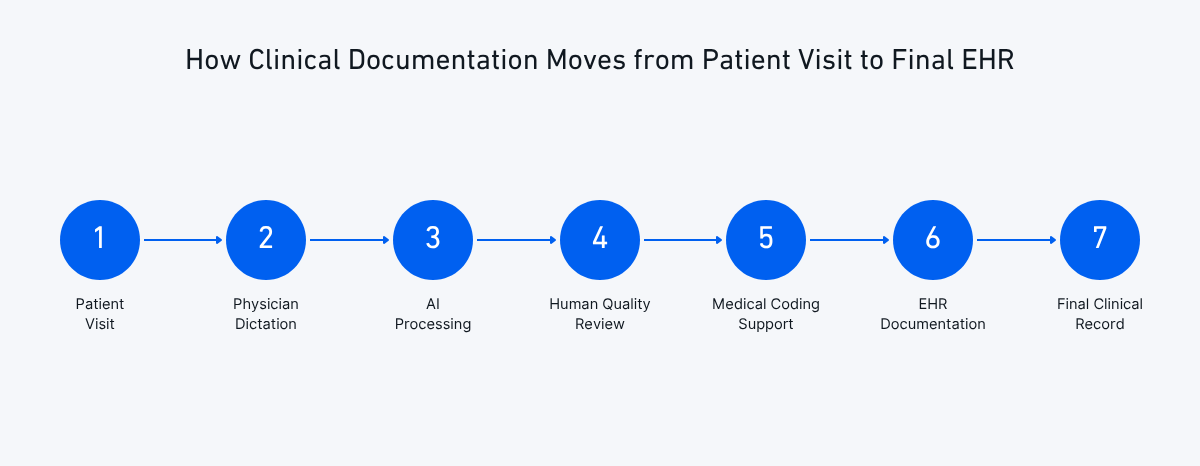
Many healthcare organizations no longer see AI and Human Medical Transcription as competing solutions. Instead, they combine both to improve efficiency while maintaining documentation quality.
In a hybrid documentation workflow:
- An AI Medical Scribe captures physician conversations and creates an initial draft.
- AI Medical Transcription converts dictation into structured clinical notes.
- A trained Human Medical Transcription specialist reviews the draft for medical terminology, specialty-specific details, formatting, and accuracy.
- Medical Coding professionals ensure documentation supports accurate coding and reimbursement.
- Virtual Medical Scribes and Virtual Medical Assistants further streamline administrative and clinical workflows by assisting physicians with documentation, scheduling, patient communication, and EHR management.
This approach helps healthcare providers reduce administrative burden while maintaining the documentation standards required for quality patient care and regulatory compliance.
For many U.S. hospitals, specialty clinics, and physician groups, a hybrid documentation model delivers the best balance of speed, accuracy, and cost-effectiveness.
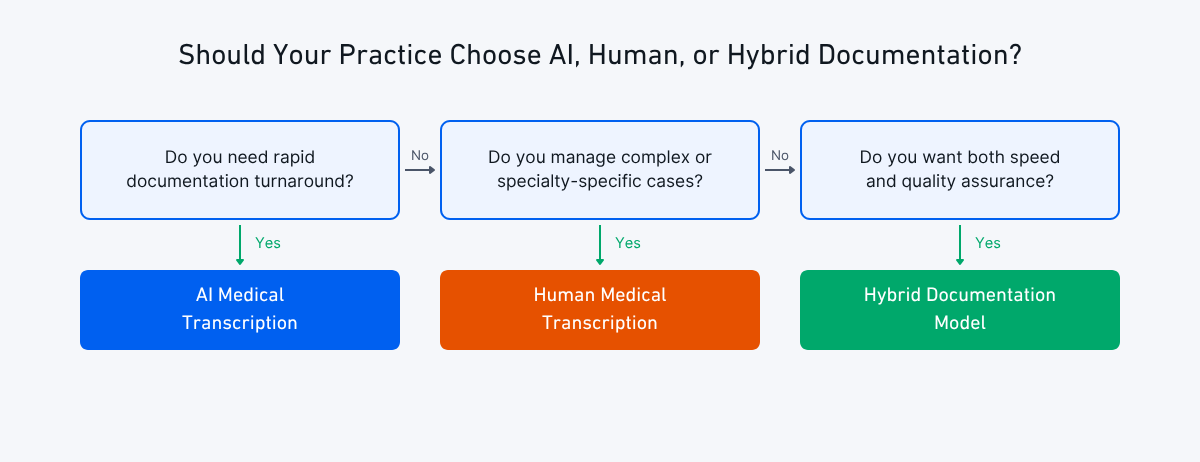
Which Documentation Solution
Is Right for Your Practice?
Every healthcare organization has different documentation needs. Choosing the right solution depends on patient volume, specialty, compliance requirements, and available resources.
Small Physician Practices
AI Medical Transcription can help reduce documentation time for routine visits. Pairing it with periodic human review ensures greater accuracy without significantly increasing costs.
Multi-Specialty Clinics
Practices managing multiple specialties benefit from a hybrid approach. AI improves efficiency, while experienced transcriptionists ensure terminology remains accurate across different specialties.
Hospitals and Health Systems
Hospitals handle diverse patient populations and complex clinical documentation. Human Medical Transcription combined with AI-assisted workflows provides reliable documentation while supporting quality assurance and compliance initiatives.
Emergency Departments
Emergency physicians require fast documentation turnaround without sacrificing accuracy. Hybrid documentation helps maintain speed while reducing transcription errors in high-pressure environments.
Behavioral Health Practices
Behavioral health documentation often includes detailed narratives and nuanced patient conversations. Human review is particularly valuable for preserving context and ensuring complete clinical records.
Radiology, Cardiology, and Orthopedic Practices
Specialty practices frequently use advanced medical terminology. Experienced transcription professionals help maintain documentation accuracy while supporting coding and reimbursement.
Why Documentation Quality
Impacts Patient Care and Revenue
Clinical documentation influences much more than medical records. It affects patient outcomes, financial performance, compliance, and operational efficiency.
Accurate documentation helps healthcare organizations:
- Improve patient safety
- Reduce coding errors
- Support cleaner insurance claims
- Minimize claim denials
- Strengthen HIPAA compliance
- Improve care coordination
- Enhance EHR documentation quality
- Support clinical decision-making
Incomplete or inaccurate documentation can delay reimbursements, increase administrative workload, and create compliance risks.
Investing in high-quality Clinical Documentation Services helps healthcare providers maintain accurate patient records while improving operational performance.
Final Thoughts
AI continues to reshape healthcare documentation, offering impressive speed and automation. However, technology alone cannot replace the expertise required to interpret complex medical terminology, specialty-specific language, and nuanced clinical conversations.
For many U.S. healthcare providers, the most effective solution is not choosing between AI and Human Medical Transcription it is combining both.
A hybrid documentation strategy allows physicians to spend less time on paperwork while maintaining the documentation accuracy needed for patient care, regulatory compliance, and revenue cycle success.
Whether your organization is a growing private practice, a multi-specialty clinic, or a large healthcare system, selecting the right documentation partner can improve efficiency, reduce physician burnout, and strengthen clinical documentation quality.
Improve Documentation Accuracy
Without Slowing Down Your Practice
Looking for a documentation solution that combines the speed of AI with the precision of experienced healthcare professionals?
Chase Clinical Documentation provides HIPAA-compliant Medical Transcription Services, AI-assisted documentation support, Virtual Medical Scribes, Virtual Medical Assistants, Medical Coding Services, and comprehensive Clinical Documentation Solutions tailored to U.S. healthcare organizations.
Contact our team today to discover how a customized documentation strategy can help your physicians spend more time with patients and less time on paperwork.
FAQ
What is the difference between AI Medical Transcription and Human Medical Transcription?
AI Medical Transcription automatically converts physician speech into clinical documentation using artificial intelligence. Human Medical Transcription involves trained specialists who review, edit, and verify documentation for accuracy, medical terminology, and compliance. Many healthcare organizations combine both approaches to improve speed while maintaining documentation quality.
Is AI Medical Transcription accurate enough for hospitals?
AI Medical Transcription performs well for routine documentation but may struggle with complex terminology, multiple speakers, specialty-specific language, and contextual interpretation. Hospitals often pair AI with human review to improve documentation accuracy and reduce clinical risks.
Why do healthcare providers still use Human Medical Transcription?
Human Medical Transcription provides contextual understanding, quality assurance, accurate medical terminology, and compliance support. It remains valuable for complex clinical documentation, specialty practices, and healthcare organizations requiring high documentation accuracy.
Which documentation solution is best for physicians?
The best solution depends on practice needs. AI supports faster documentation, while Human Medical Transcription improves quality and accuracy. Many U.S. healthcare providers achieve the best results by combining AI-assisted documentation with expert human review.
Can Medical Transcription Services integrate with Electronic Health Records (EHRs)?
Yes. Many Medical Transcription Services integrate with leading EHR platforms, allowing providers to streamline documentation workflows while maintaining secure clinical records.
Can AI Medical Scribes replace Human Medical Transcription completely?
AI Medical Scribes significantly improve documentation efficiency but do not eliminate the need for human expertise. Human review remains essential for complex cases, quality assurance, compliance, and specialty documentation.
Recent Posts