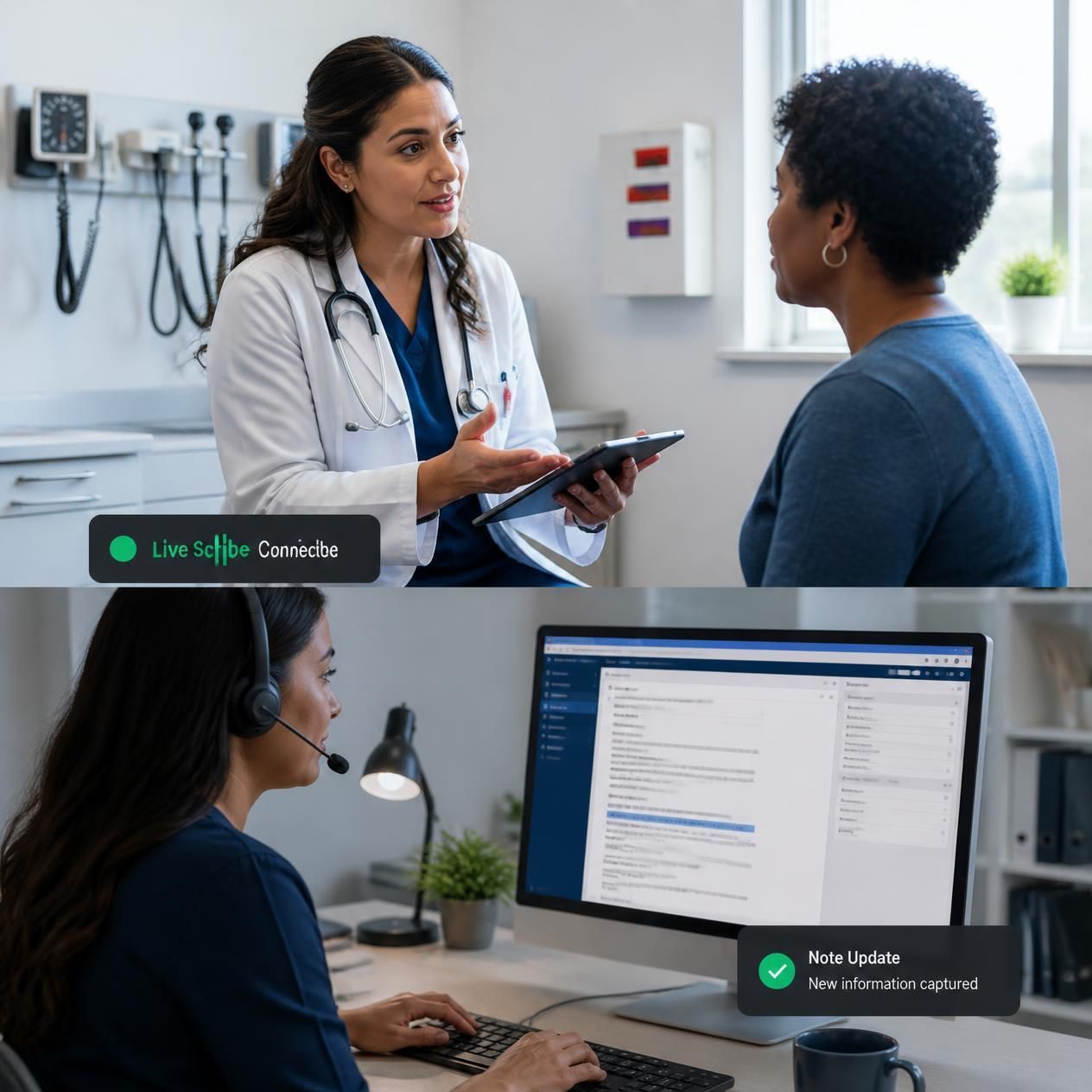
Integrating AI Scribe services into existing Electronic Medical Records (EMR) systems is a strategic step that can significantly enhance the efficiency and accuracy of medical documentation. This integration allows healthcare providers to streamline their clinical documentation processes, making them more time-efficient and less prone to errors. Chase Clinical Documentation is dedicated to ensuring that our AI Scribe services integrate seamlessly with various EMR systems. Here’s a step-by-step guide on how to successfully integrate AI Scribe technology into your existing EMR systems, focusing on compatibility and ease of use. 

Step 1: Assess Your Current EMR System

Evaluate Compatibility

Before integrating an AI Scribe, assess the compatibility of the AI technology with your existing EMR system. Ensure that the AI Scribe can interact with the EMR’s database and user interface without issues. 

Identify Integration Points

Determine where and how the AI Scribe will interact with the EMR. Common integration points include patient data retrieval, note entry, and data update functions. 


Step 2: Choose the Right AI Scribe Service

Vendor Selection

  • Select a provider like Chase Clinical Documentation that offers AI Scribe services known for reliability and compatibility with a wide range of EMR systems. 

Service Customization

  • Opt for an AI Scribe service that allows customization to meet the specific needs of your practice and that aligns with the workflows of your EMR system. 

Step 3: Plan the Integration

Integration Strategy

  • Develop a clear integration strategy that outlines the technical steps, resources required, and timelines. Consider whether the integration will be direct or if it will require middleware. 

Compliance and Security

  • Ensure the integration plan complies with healthcare regulations such as HIPAA. Plan for the secure handling of data exchanges between the AI Scribe and the EMR. 

Step 4: Implement the AI Scribe

Technical Setup

  • Work with the AI Scribe provider’s technical team to implement the service. This might involve installing software, setting up APIs, or configuring middleware solutions. 

Testing

  • Conduct thorough testing to ensure that the AI Scribe works correctly with the EMR. Test for functionality, data accuracy, and user interaction. 

Step 5: Train Staff

Training Programs

  • Develop comprehensive training programs for staff who will use or interact with the AI Scribe. Focus on how to use the system, best practices, and troubleshooting common issues. 

Support Systems

  • Set up a support system for ongoing questions and technical support. Ensure staff know who to contact for help and how to access resources. 

Step 6: Monitor and Optimize

Performance Monitoring

  • After implementation, continuously monitor the performance of the AI Scribe integration. Look for areas where the process can be improved or where further customization is needed. 

Feedback Loops

  • Establish feedback loops with staff to gather insights on the system’s performance and usability. Use this feedback to refine and optimize the AI Scribe’s functionality. 

Streamlining Clinical Documentation with AI

Integrating AI Scribe services into your EMR system is a powerful way to enhance the efficiency and accuracy of clinical documentation. By following these detailed steps, healthcare providers can ensure a smooth integration that leverages the full potential of AI technology. Chase Clinical Documentation is committed to supporting healthcare 

practices through this transformation, offering customized AI Scribe solutions that integrate seamlessly with existing EMR systems, thus enhancing the overall care delivery process. 


Recent Posts

Detailed Guide on Integrating AI Scribe Services into Existing EMR Systems


Healthcare appointment scheduling calendar icon

Virtual medical scribe pricing models including hourly, dedicated, shared, and hybrid coverage
By Chase Clinical documentation September 11, 2026
Explore virtual medical scribe cost in the USA, pricing models, staffing ratios, and ROI to help medical practices choose the right scribe solution.
Small medical practice using virtual medical scribe support for clinical documentation
By Chase Clinical documentation September 10, 2026
Is a virtual medical scribe worth it for your small practice? This decision guide covers cost, workflow fit, and when a scribe genuinely solves the right problem.
Primary care physician providing patient care with virtual medical documentation support
By Chase Clinical documentation September 8, 2026
Managing 20+ patient encounters daily? A virtual medical scribe for primary care can support SOAP note drafting and reduce after-hours charting.
Virtual medical scribe drafting clinical note during complex multi-condition patient encounter
By Chase Clinical documentation September 4, 2026
Complex patient histories demand accurate, structured documentation. How a virtual medical scribe handles multi-condition visits so physicians stay focused on care.
One virtual medical scribe supporting multiple physicians simultaneously
By Chase Clinical documentation September 3, 2026
One virtual medical scribe can support multiple physicians when the workflow fits. Learn what determines scribe capacity and right staffing ratio for your practice.
Physician using AI medical scribe technology to document a patient visit efficiently.
By Chase Clinical documentation August 21, 2026
Learn how to train physicians to use an AI medical scribe, review clinical notes, improve adoption, and maintain accurate clinical documentation.
Post-visit virtual medical scribe creating clinical documentation from encounter information
By Chase Clinical documentation August 21, 2026
Compare live and post-visit virtual medical scribe workflows. Understand which scribing model fits your practice's encounters, EHR workflow, and documentation needs.
Virtual medical scribe supporting a physician with remote clinical documentation
By Chase Clinical documentation August 19, 2026
Virtual medical scribe vs. an in-house scribe? Compare staffing, costs, EHR workflow, and scalability to find the right documentation model for your practice.
AI Medical Scribe supporting clinical documentation, medical coding, and electronic health record
By Chase Clinical documentation August 11, 2026
See how AI Medical Scribe technology supports ICD-10 and CPT code capture, reduces undercoding, improves documentation, and helps prevent claim denials.
Show More
Medical scheduling and documentation management icon
June 4, 2024

Detailed Guide on Integrating AI Scribe Services into Existing EMR Systems

Virtual medical scribe pricing models including hourly, dedicated, shared, and hybrid coverage
By Chase Clinical documentation September 11, 2026
Explore virtual medical scribe cost in the USA, pricing models, staffing ratios, and ROI to help medical practices choose the right scribe solution.
Small medical practice using virtual medical scribe support for clinical documentation
By Chase Clinical documentation September 10, 2026
Is a virtual medical scribe worth it for your small practice? This decision guide covers cost, workflow fit, and when a scribe genuinely solves the right problem.
Primary care physician providing patient care with virtual medical documentation support
By Chase Clinical documentation September 8, 2026
Managing 20+ patient encounters daily? A virtual medical scribe for primary care can support SOAP note drafting and reduce after-hours charting.
Virtual medical scribe drafting clinical note during complex multi-condition patient encounter
By Chase Clinical documentation September 4, 2026
Complex patient histories demand accurate, structured documentation. How a virtual medical scribe handles multi-condition visits so physicians stay focused on care.
One virtual medical scribe supporting multiple physicians simultaneously
By Chase Clinical documentation September 3, 2026
One virtual medical scribe can support multiple physicians when the workflow fits. Learn what determines scribe capacity and right staffing ratio for your practice.
Physician using AI medical scribe technology to document a patient visit efficiently.
By Chase Clinical documentation August 21, 2026
Learn how to train physicians to use an AI medical scribe, review clinical notes, improve adoption, and maintain accurate clinical documentation.
Post-visit virtual medical scribe creating clinical documentation from encounter information
By Chase Clinical documentation August 21, 2026
Compare live and post-visit virtual medical scribe workflows. Understand which scribing model fits your practice's encounters, EHR workflow, and documentation needs.
Virtual medical scribe supporting a physician with remote clinical documentation
By Chase Clinical documentation August 19, 2026
Virtual medical scribe vs. an in-house scribe? Compare staffing, costs, EHR workflow, and scalability to find the right documentation model for your practice.
AI Medical Scribe supporting clinical documentation, medical coding, and electronic health record
By Chase Clinical documentation August 11, 2026
See how AI Medical Scribe technology supports ICD-10 and CPT code capture, reduces undercoding, improves documentation, and helps prevent claim denials.
Physician using AI Medical Scribe during patient encounter with NLP-powered clinical documentation
By Chase Clinical documentation August 7, 2026
How NLP in medical scribing enables AI Medical Scribes to understand physicians, interpret clinical language, and generate accurate EHR documentation automatically.
More Posts